Furnishing an Empty Room: Where to Start (Step by Step)
A bare room is exciting and slightly terrifying. There are no walls to work around, no existing sofa to match — just blank floor and a budget. That freedom is exactly what makes people freeze. If you have ever wondered how to furnish an empty room without ending up with a mismatched pile of impulse buys, this guide gives you the order to do it in. Work through these steps top to bottom and the room more or less designs itself.
Start with the focal point and an anchor piece
Every well-furnished room has a focal point — the thing your eye lands on when you walk in. Sometimes the architecture decides it for you: a fireplace, a big window with a view, a bay. If the room gives you nothing, you create one with an anchor piece: the sofa in a living room, the bed in a bedroom, the table in a dining room.
Pick that anchor first, before anything else. It is usually the largest, most expensive, longest-lived item, so it sets the budget, the scale, and the mood for everything that follows. Decide where it goes, then arrange the rest of the room in conversation with it. Choosing the anchor before the accessories is the single biggest difference between a room that feels intentional and one that feels accumulated.
Get scale and proportion right
The most common mistake in an empty room is buying furniture that is the wrong size for the space. A tiny loveseat floats in a large living room; an oversized sectional swallows a small one. Both read as “wrong” even when the piece itself is lovely.
Measure the room and the doorways before you shop, then tape out the footprint of big pieces on the floor with painter’s tape. Stand in the room. Can you see the proportions? A good rule for sofas is roughly two-thirds the length of the wall they sit against. Coffee tables sit at about two-thirds the length of the sofa. Leave breathing room — furniture pushed wall to wall makes a room feel smaller, not bigger.
Scale is hard to judge from a catalogue photo. Previewing pieces at size in your actual room removes most of the guesswork, which is exactly what the Redesign Layout demo is built for — drop in a photo of the empty room and see furniture placed and sized in the real space.
Plan layout and traffic flow
Before you commit to an arrangement, think about how people move through the room. There should be a clear path from each doorway to the main seating or to the next room, ideally 90–120 cm wide for primary walkways. Nobody should have to squeeze past the sofa to reach the window.
Group seating so people can talk without shouting — conversation areas work best when seats are within about 2.5 metres of each other. In open-plan spaces, use furniture to define zones: the back of a sofa can mark where the living area ends and the dining area begins. Sketch two or three layouts and “walk” each one in your head before buying. Architectural AI lets you generate several arrangements of the same empty room so you can compare flow side by side instead of imagining it.
Build up the layers: rug, lighting, art
A room with only big furniture feels unfinished. Layers are what make it feel lived-in.
- Rug. Buy big. The rug should be large enough that at least the front legs of all the main seating sit on it; a rug that is too small makes the whole arrangement look like it is shrinking. The rug also visually anchors the seating zone.
- Lighting. Aim for at least three light sources at different heights — overhead, a floor or table lamp, and something low or accent. Layered light is the fastest way to make a room feel warm rather than clinical. Skip relying on a single ceiling fixture.
- Art and the vertical plane. Empty walls keep a room feeling temporary. Hang art at eye level (centre around 145–150 cm), and let larger pieces relate to the furniture below them. Mirrors bounce light and make small rooms feel bigger.
Choose a colour direction
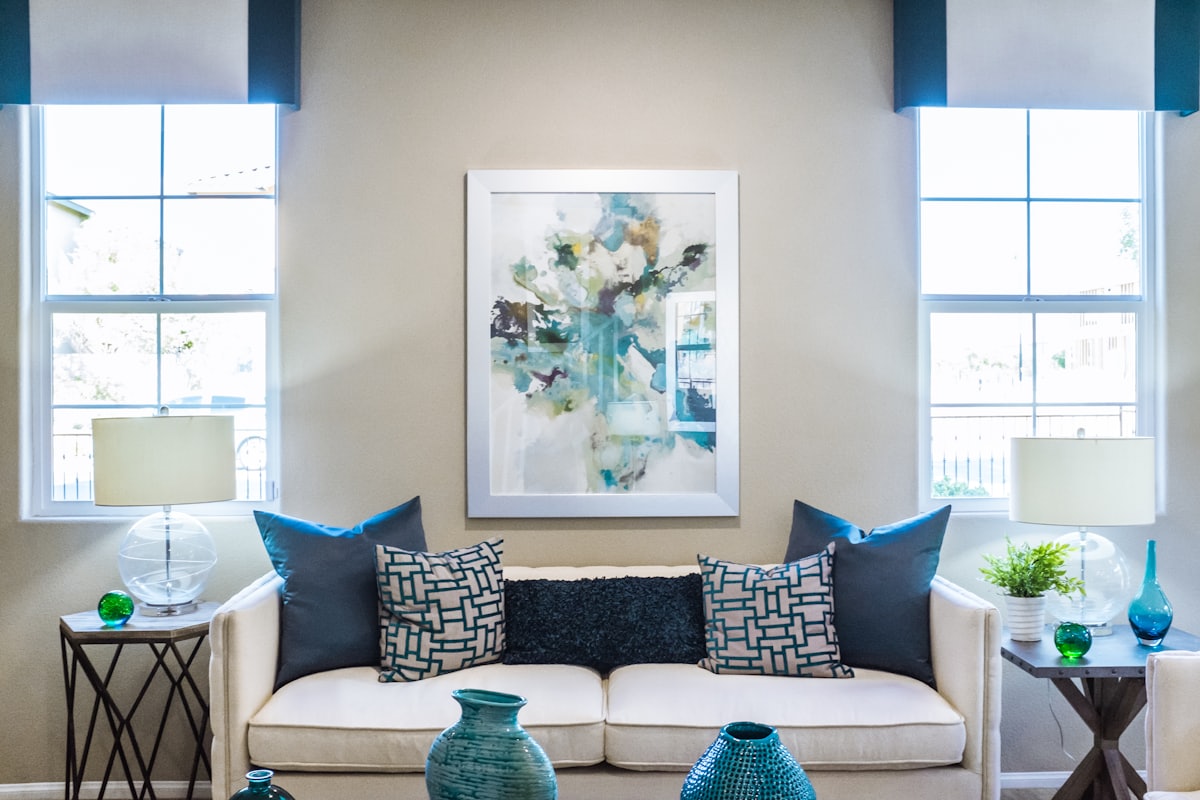
With the bones in place, lock in a colour story so your layers do not fight each other. A reliable starting point is the 60-30-10 rule: 60% a dominant neutral (walls, large furniture), 30% a secondary colour (rug, curtains, an accent chair), and 10% an accent (cushions, art, smaller objects).
Pull your palette from the anchor piece or the rug rather than choosing colours in the abstract. If your sofa is warm grey, build around it. Testing a colour direction on the real room first saves expensive mistakes — browse Architectural AI styles to see how the same empty space reads in Scandinavian, Japandi, mid-century, or industrial palettes, and explore themed worlds when you want a stronger mood to anchor the whole scheme.
Buy in the right order
Furnishing on a budget is mostly about sequencing. Buy in this order:
- The anchor piece (sofa / bed / dining table). Spend the most here — it is used daily and lasts longest.
- Rug, because it defines the zone and you want furniture to relate to it.
- Secondary seating and storage (chairs, sideboard, nightstands).
- Lighting.
- Soft layers and art (cushions, throws, curtains, wall pieces).
Resist buying decor first; accessories are easy and addictive, but they make weak decisions feel finished and lock you into a direction before the big pieces arrive. Leave the smallest, cheapest, most replaceable items for last.
Preview before you buy
The whole point of working in this order is to make confident, expensive decisions once. Architectural AI previews furniture styles and arrangements directly on a photo of your empty room — use Redesign Layout to test scale and flow, and styles to test the colour and mood — so you can see the finished room before you spend a cent.
Not sure where to begin with your specific space? Ask Architectural AI for tailored suggestions, or read more practical walkthroughs on the blog.
Ready to see your empty room furnished? Try the Architectural AI demo and preview real layouts and styles on your own photo in seconds.
Keep reading