Ming Pavilion Interiors: Classical Chinese Design and How to Use It Today
A search for “Ming pavilion” usually starts with an image: a small open structure with an upturned tiled roof, sitting at the edge of water, framed by rock and pine. What’s worth knowing is that the interior logic behind it is one of the most disciplined design traditions in existence — and considerably more usable in a modern home than most people expect.
What a pavilion actually is
A pavilion — ting — is a light, open structure in a classical Chinese garden. Its purpose isn’t shelter in any serious sense. It’s a place to stop, sit, and look at something that has been deliberately composed for you to look at.
That reframes the whole design brief. The architecture is not the subject; it’s the frame. Everything about a pavilion — its openness, its restraint, its careful placement — exists to direct attention outward.
This is the single most useful idea to steal, and it costs nothing: decide what the view is, then arrange the room to frame it. A window, a courtyard, a single plant, a piece of art.
Ming furniture: the ancestor of minimalism
Ming-dynasty furniture (roughly 14th–17th century) is the part of this tradition that modern designers have quietly borrowed from for a century.
Its characteristics:
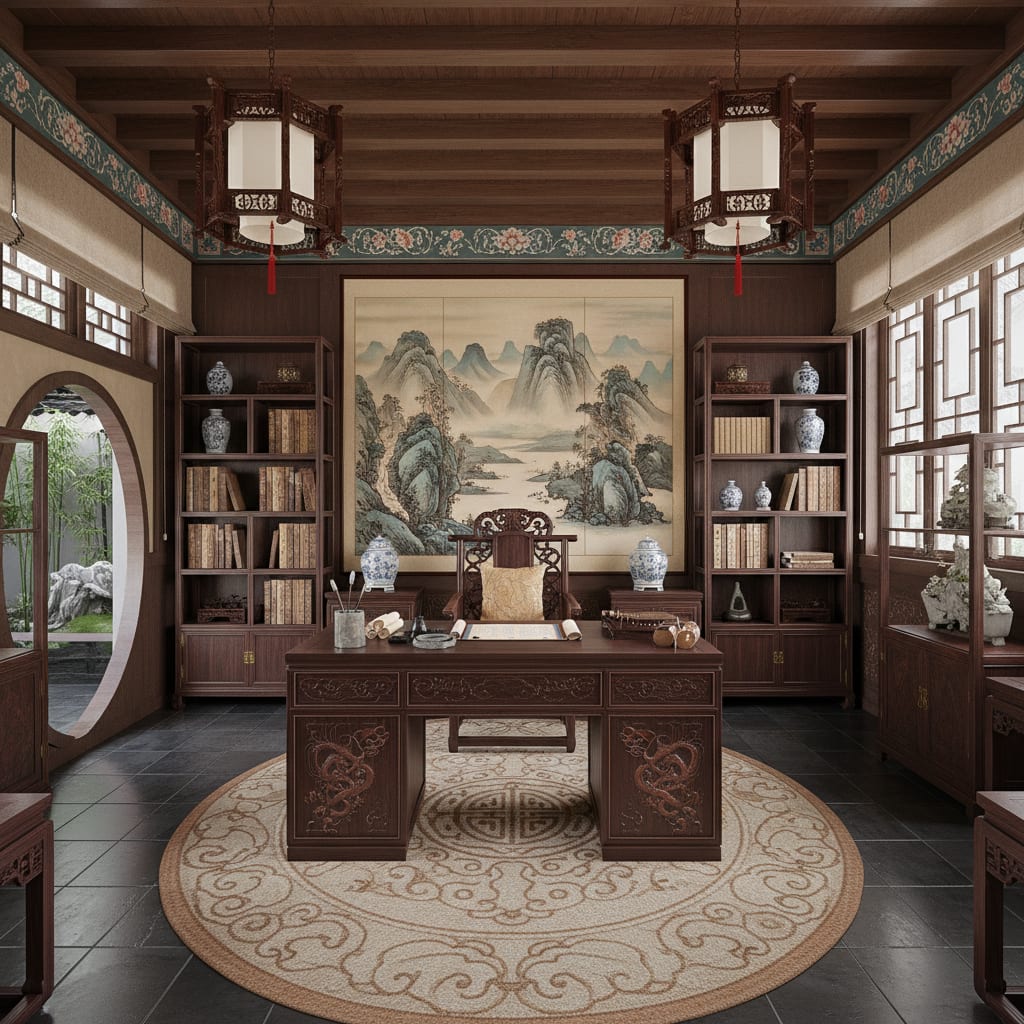
- Fine hardwoods — huanghuali, zitan — with the grain left visible and unpainted.
- Almost no ornament. Where later Qing pieces are heavily carved, Ming pieces are nearly bare.
- Mortise-and-tenon joinery, assembled without nails or glue, with the joints often expressed rather than hidden.
- Elegant, slightly curved lines — a yoke-back chair’s crest rail, the gentle splay of a leg.
- Generous negative space within the piece itself.
If you’ve ever admired a Danish modern chair, you’ve admired something with Ming ancestry. A single authentic-style Ming chair or a low altar-table console sits comfortably in a contemporary room, which is why it’s the easiest entry point.
Lattice screens and the art of partial concealment
The lattice panel — geometric wooden fretwork, sometimes backed with paper or silk — is the signature architectural element.
Its function is philosophical as much as practical: it divides without closing, and it reveals partially. You see through it and around it, never all at once.
Modern applications:
- A freestanding lattice screen as a room divider in an open-plan space — far better than a solid partition because it zones without darkening.
- A lattice panel mounted flat on a wall as art, backed with paper and lit from behind.
- Lattice inserts in cabinet doors or as a headboard.
- A lattice-pattern window film for privacy that keeps the light.
If you’re working with an open-plan layout, our open plan living zoning ideas guide covers the same divide-without-closing problem in modern terms.
Palette: wood, ink, cream, one accent
Classical Chinese interiors run on a short, warm-neutral palette:
- Dark hardwood — rosewood, walnut tones — as the structural colour.
- Ink black in lacquer, calligraphy, and metal.
- Cream and rice-paper white on walls and paper panels.
- One saturated accent: jade green, vermilion red, or imperial yellow — used in a cushion, a lacquer box, a ceramic piece. Never across a whole wall.
The frequent misunderstanding is that Chinese interiors are red and gold. That’s a festival palette, not a domestic one. Ming domestic interiors are quiet.
Materials and objects
- Silk on cushions and scroll mountings.
- Rice paper on screens and lanterns — diffused light is central to the atmosphere.
- Porcelain: blue-and-white is the correct period reference, ideally one good piece rather than a collection.
- Stone: a scholar’s rock, an ink stone, a stone base under a plant.
- Bamboo and pine as living material, and as motif.
Lighting
Diffused and low. Paper lanterns, shaded table lamps, and light passing through lattice or paper screens. Warm 2700K, dimmable, and never a single bright overhead source.
A backlit lattice panel is the most striking single lighting move in this style and reads beautifully at night.
The restraint problem
The most common failure with Chinese-influenced interiors is accumulation: a lattice screen and a red wall and a dragon motif and gold hardware and several porcelain pieces. The result feels like a restaurant.
Ming design is subtractive. One screen. One hardwood piece. One porcelain object. One accent colour. A lot of empty wall and empty floor. If a room feels slightly too bare, you’re probably close to correct.
Adjacent styles
If the discipline appeals but you want a different register, the Japandi approach shares the restraint with a lighter palette, and Zen Minimalism sits between the two.
Preview it on your own room
Dark hardwood and a lattice screen read very differently at 2.4 m ceilings than at 3.5 m, and that’s hard to judge from reference photos of pavilions.
With Architectural AI, photograph your room and restyle it as the Ming Dynasty Chamber or the Chinese Phoenix Sanctuary in seconds, on your own walls. Try the demo, browse the worlds catalog, or ask a question in our AI designer.
The bottom line
The Ming pavilion’s real lesson isn’t ornamental — it’s that a room should frame something and then get out of the way. A lattice screen, one hardwood piece with honest joinery, a short warm palette, diffused light, and a great deal of empty space. Everything else is subtraction.
Download Architectural AI and see your room in classical Chinese dress.
FAQ
What is a Ming pavilion? A pavilion (ting) is a light open structure in a classical Chinese garden, designed as a place to pause and look out at a composed view. Ming-dynasty pavilions are defined by exposed hardwood frames, latticework panels, upturned tiled roofs and deliberate framing of the landscape — the architecture exists to direct attention outward.
What defines Ming dynasty furniture? Restraint and joinery. Ming furniture uses fine hardwoods such as huanghuali and zitan, minimal ornament, elegant curved lines and mortise-and-tenon joints assembled without nails or glue. Its clean proportions are why it is often described as the ancestor of modern minimalist furniture.
How do I bring classical Chinese design into a modern home? Use four elements rather than a full recreation: a lattice screen or panel as a room divider, one piece of dark hardwood furniture with visible joinery, a restrained palette of warm wood, ink black, cream and one jade or vermilion accent, and a deliberately framed view or arrangement. Restraint is the style, so adding more works against it.
Can I preview a Chinese classical style on my room? Yes. Architectural AI includes Ming Dynasty Chamber and Chinese Phoenix Sanctuary worlds that restyle a photo of your real room into classical Chinese interiors in seconds, which lets you test how the dark hardwood and lattice read against your own light and ceiling height.
Keep reading