What Is a Spa Bathroom? The Definition, the Five Elements, and What It Isn't
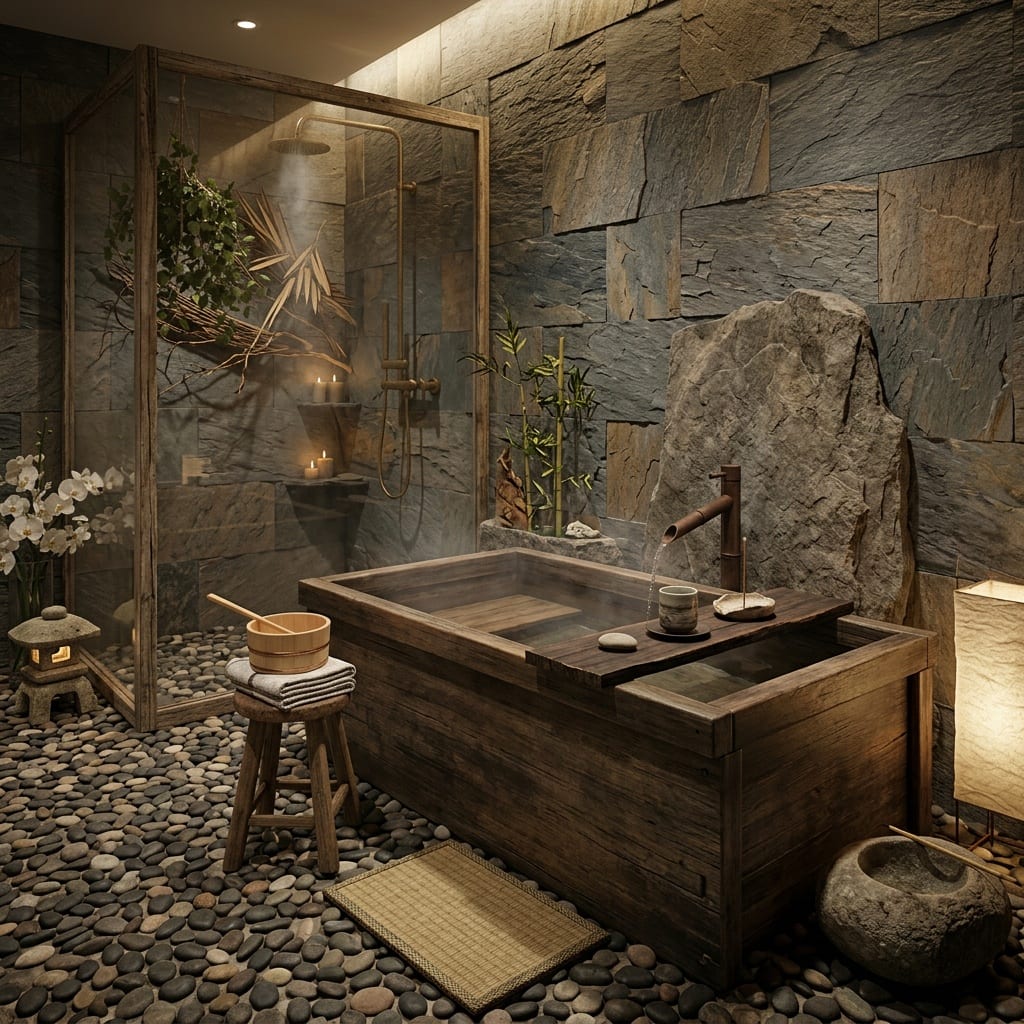
“Spa bathroom” is one of those phrases everyone uses and almost nobody defines. It gets attached to any bathroom with a freestanding tub, a stack of rolled towels, or a beige tile. That vagueness is why so many spa bathroom renovations end up expensive and still not relaxing.
So let’s be precise about it.
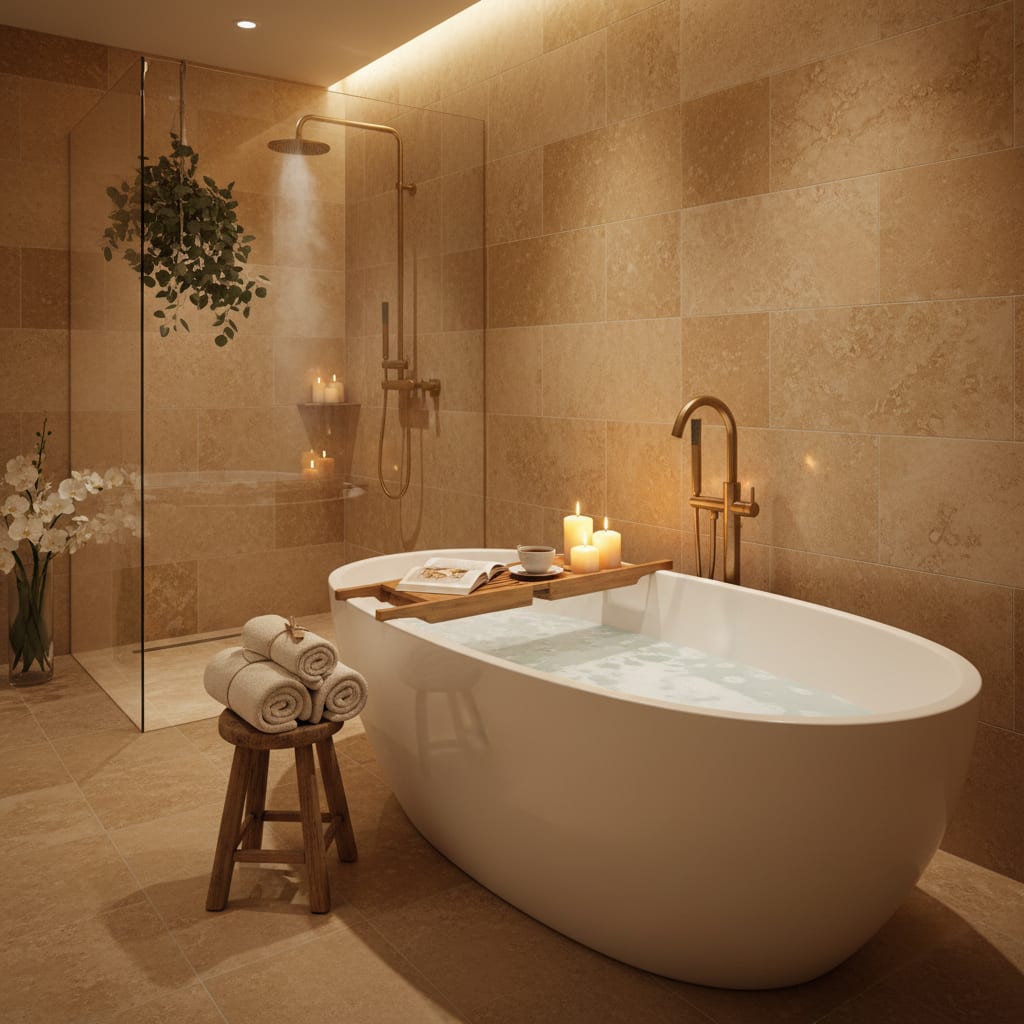
A spa bathroom is a bathroom designed to reduce sensory stimulation rather than add features. Everything that defines one follows from that single principle: fewer colors, softer light, natural textures, clear surfaces, and something alive. Cost, square footage, and whether there’s a tub are all secondary — and that’s not a consolation prize, it’s the actual mechanism.
The five elements that define a spa bathroom
1. A low-saturation natural palette
Spa bathrooms sit in a narrow band of color: warm white, sand, oatmeal, greige, clay, sage, and soft stone tones. These reflect light gently and give the eye nothing to snag on.
What breaks it: high-contrast combinations, cool blue-based whites (which read clinical rather than calm), and more than three tones in one room.
2. Warm, layered, dimmable light
This is the element people skip and the one that matters most. A single bright ceiling fixture flattens the room and throws hard shadows — the exact opposite of a spa.
A spa bathroom has at least two light sources at different heights, all at 2700K warm white, and at least one of them on a dimmer. The ability to drop the light to a low glow in the evening is not a nice-to-have; it is the spa.
3. Authentic natural materials
Stone, honed marble, travertine, unglazed ceramic, teak, light oak, linen, cotton. Materials that came from something rather than materials that imitate something.
You don’t need them everywhere. A stone soap dish, a teak stool, and a wooden bath mat introduce the tactile quality that makes a bathroom feel grounded, even if the tile stays exactly as it is.
4. Clear surfaces
A spa bathroom looks open because the countertop and tub edge are essentially empty. This is where the word “spa” and the word “bathroom” usually part ways in real homes: most bathrooms have eleven products on display.
The standard is strict — daily-use items only, everything else behind a door, and matching refillable bottles so labels don’t create visual noise. If you want to see the payoff before you start sorting, the Clean Room tool in Architectural AI generates a decluttered version of your actual bathroom.
5. One living or organic element
A plant, a branch, eucalyptus hung in the shower, or at minimum something with organic form. This is what separates a minimal bathroom from a calm one. Without it, restraint tips into sterility.
Pothos, snake plant, ZZ plant, and ferns all tolerate bathroom humidity and low indirect light.
What a spa bathroom is not
Three things get mistaken for spa design constantly:
It’s not a jetted tub. A whirlpool tub under a bright ceiling light in a cluttered room is a feature, not an atmosphere. Plenty of shower-only bathrooms read as more spa-like.
It’s not all-white. Pure cool white with chrome and bright light is a clinical bathroom. The spa version is warm-white or off-white with texture. This is the single most common miss.
It’s not expensive tile. You can spend heavily on stone and still end up with a bathroom that feels tense, because the light is cold and the counter is full. Material quality helps only after palette, lighting, and clutter are handled.
Spa bathroom vs. luxury bathroom
These get used interchangeably and shouldn’t be:
| Spa bathroom | Luxury bathroom | |
|---|---|---|
| Goal | Lower stimulation | Signal quality |
| Palette | Soft, 2-3 tones | Can be high-contrast |
| Lighting | Warm, dim, layered | Often bright, statement fixtures |
| Materials | Natural, matte | Premium, often polished |
| Feeling | Calm | Impressive |
They overlap often, but not always. A marble-and-gold bathroom with a crystal fixture is luxury, not spa. A small oak-and-limewash bathroom with one warm lamp is spa, not luxury. Knowing which one you’re actually after saves a lot of money.
The order that actually works
If you’re starting from an ordinary bathroom, do it in this sequence — each step costs more than the last, and you may not need to reach the end:
- Clear every surface. Free. Biggest single change.
- Swap bulbs to 2700K. A few euros.
- Add a dimmer, or use smart bulbs if wiring isn’t an option.
- Add texture: neutral towels, a stone or wooden mat, a teak stool.
- Add a plant.
- Add closed storage so step 1 stays true.
- Only then consider paint, then tile.
Most people start at step 7 and wonder why the result doesn’t feel like the hotel.
Small bathrooms and the spa question
Small bathrooms are often easier, not harder, because there’s less surface to unify. Keep floor-to-wall tone continuous, use a large mirror, choose a frameless glass panel over a shower curtain, mount storage vertically and closed, and let one natural material be the focal point. Our guide to small bathroom design ideas covers the space-specific moves in more detail.
See it on your own bathroom first
The hardest part of any spa bathroom project is imagining a warmer wall tone or a cleared counter in a room you’ve looked at every day for years.
With Architectural AI you can photograph your real bathroom and preview the spa version instantly — test a calming wall color with Change Wall Color, drop in greenery with Add Plants, and clear the clutter with Clean Room, all on your actual room. Start in the demo, or explore reference environments like the Spa Bathroom world and the Japanese Onsen in the worlds catalog. For a deeper walkthrough of the ideas, read our spa bathroom ideas guide, and bring specific questions to our AI designer.
The short answer
A spa bathroom is a bathroom that asks less of your attention. Soft palette, warm dim light, natural texture, empty surfaces, something alive. Three of the five cost nothing. Start there before you price a single tile.
Download Architectural AI and see your bathroom as a spa in seconds.
FAQ
What is a spa bathroom? A spa bathroom is a bathroom designed to reduce sensory stimulation rather than add features. It is defined by five things: a low-saturation natural palette, warm layered lighting on a dimmer, authentic natural materials, clear uncluttered surfaces, and at least one living or organic element. A bathroom with a jetted tub but harsh overhead light and cluttered counters is not a spa bathroom.
What is the difference between a spa bathroom and a luxury bathroom? A luxury bathroom signals value through materials and fixtures — marble, gold, statement tubs. A spa bathroom signals calm through restraint — soft tones, hidden storage, warm dim light. They overlap, but a bathroom can be expensive and stimulating (luxury, not spa) or inexpensive and deeply calming (spa, not luxury).
Do you need a bathtub for a spa bathroom? No. A tub helps, but the spa feeling comes from the palette, the lighting, and the absence of clutter. A small shower-only bathroom with warm dimmable light, a stone bath mat, folded neutral towels, and clear surfaces reads as more of a spa than a large bathroom with a tub and a bright ceiling fixture.
How much does it cost to make a bathroom feel like a spa? The three highest-impact changes are effectively free or under the price of a dinner out: clearing every product off the counter, swapping cool bulbs for warm 2700K ones, and adding a dimmer. Materials, plants, and quality towels come after that, and a full retile is rarely what separates a spa bathroom from an ordinary one.
Keep reading