Zen Garden Ideas: Turn Your Backyard Into a Calm Retreat
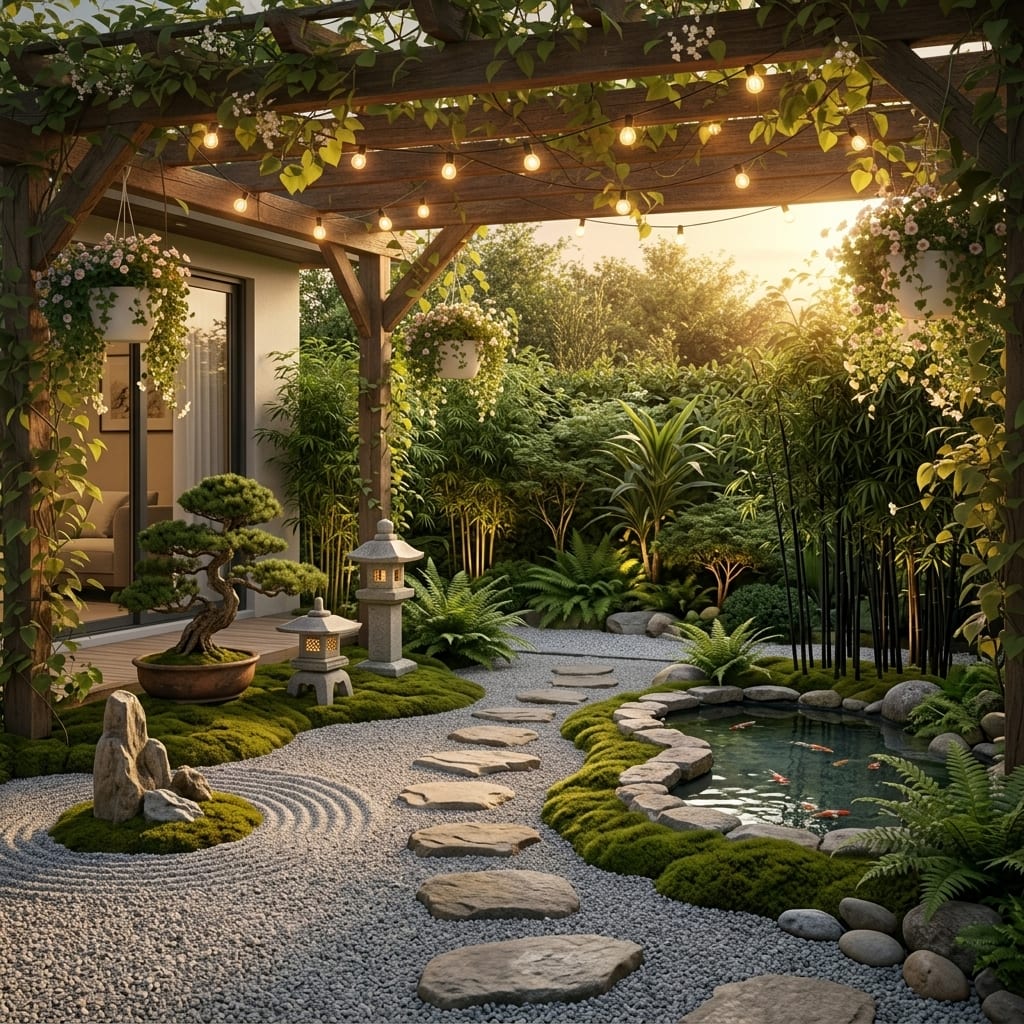
The best zen garden ideas for a backyard all start from the same quiet principle: take things away until what remains feels inevitable. Raked gravel, a few well-placed stones, moss, one thread of water — that’s the entire vocabulary, and it turns even a modest suburban plot into somewhere your shoulders drop the moment you step outside. Before you move a single rock, you can preview the whole transformation on a photo of your real garden with Architectural AI — the app has a dedicated Zen Garden world that redesigns your actual backyard in seconds.
What makes a zen garden feel calm
Japanese dry gardens (karesansui) run on a handful of design principles, and knowing them stops your backyard version drifting into “gravel with ornaments”.
Emptiness is the point. Open, raked space isn’t waiting to be filled — it is the composition, the way silence is part of music. Asymmetry over symmetry: stones and plants are placed in odd-numbered, off-centre groups, never in rows. Suggestion over statement: gravel stands for water, stones for mountains or islands; the garden is a landscape in miniature, read by the imagination. And borrowed scenery — a neighbour’s tree, a distant roofline — is framed rather than fenced out.
Hold onto those four ideas and every decision below gets easier. When in doubt, remove something.
Raked gravel and stone: the bones of the garden
Start with the ground plane. An area of fine gravel or coarse sand — pale grey or buff, 8–12mm so it holds a rake line — becomes your “water”. Edge it cleanly with steel, timber or flat stone so the composition has a frame. Then place stones in groups of three or five: one dominant upright, supporting companions, all buried by a third so they look grown rather than dropped.
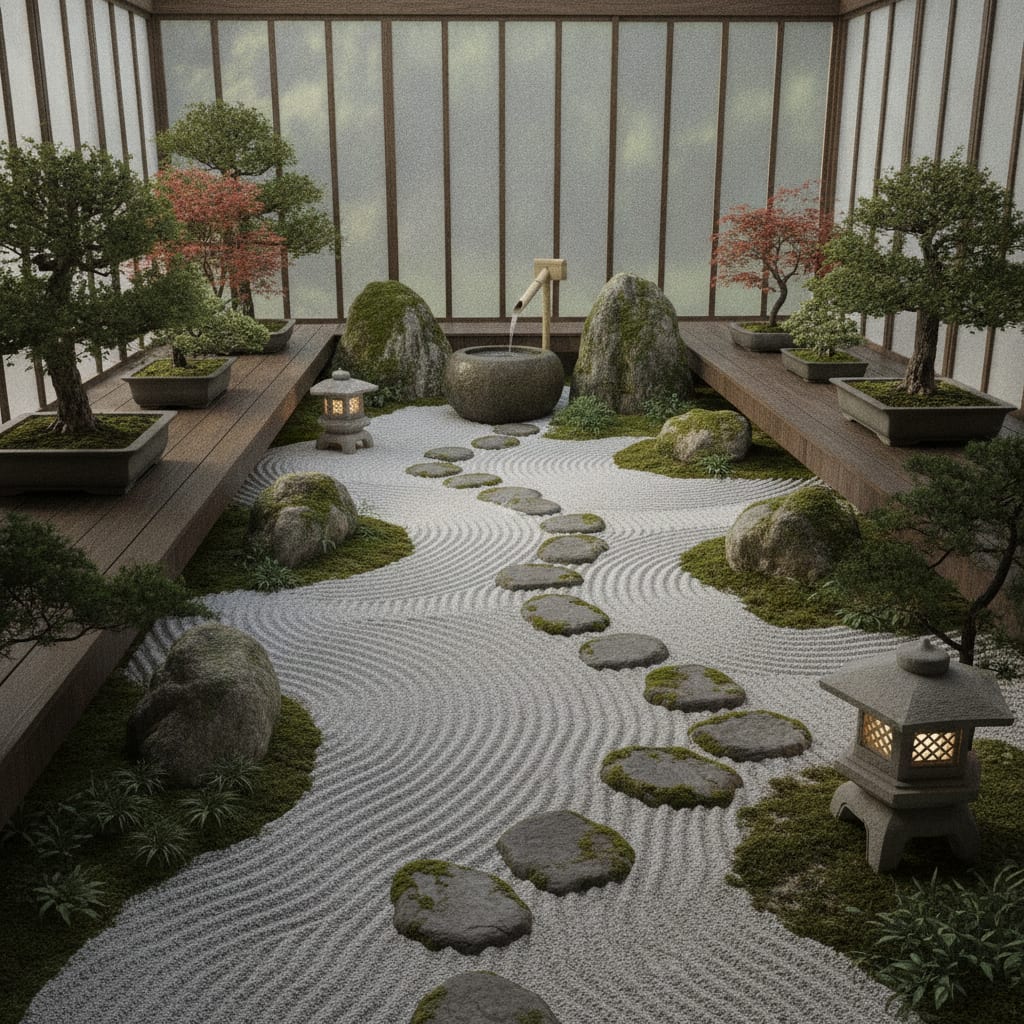
Rake in long parallel lines across open areas and concentric ripples around stones. It takes ten minutes, and redoing it is half the pleasure — a moving meditation you’ll actually keep up.
Decor tips:
- Palette: pale gravel, mid-grey stone, deep green moss — three tones, no more.
- Materials: granite or local weathered boulders; steel or stone edging; a wooden rake.
- Lighting: one low, warm ground light grazing the main stone group at night.
- Hero piece: the dominant upright stone — spend your budget and your patience here.
Moss, evergreens and restrained planting
Planting in a zen garden is structural, not decorative. Moss carpets shady ground and softens stone bases; where moss won’t take, mind-your-own-business or dwarf mondo grass gives the same low green pillow. Above it, keep to evergreens with clear silhouettes: a cloud-pruned pine or clipped box balls, ferns at the shaded edges, and bamboo along a boundary if you need screening.
Allow yourself exactly one seasonal voice — a single Japanese maple that burns red in autumn is traditional and earns its place precisely because everything around it stays constant. What you leave out matters more than what you plant: no busy borders, no colour mixes, no filler.
Decor tips:
- Palette: layered greens with one seasonal red accent.
- Materials: moss, ferns, pine, bamboo; bark or gravel mulch, never bright chips.
- Lighting: soft uplight through the maple’s canopy — one fitting, big effect.
- Hero piece: a cloud-pruned pine or a maple with genuinely good structure.
Water: sound over spectacle
You don’t need a pond. The most effective zen water feature is the smallest one: a stone basin (tsukubai) with a bamboo spout, recirculating a trickle you hear before you see. That thread of sound masks traffic, draws birds, and gives the garden a pulse without any of the maintenance a pond demands.
If your garden is fully dry, let the gravel do the work — a raked “stream” curving between stone banks reads as water to everyone who sees it. Either way, resist fountains, jets and anything that performs. Zen water whispers.
Decor tips:
- Palette: dark basin stone against pale gravel for quiet contrast.
- Materials: carved granite or a hollowed boulder; bamboo spout; hidden pump reservoir.
- Lighting: none directly on the water — let it be heard at night, not staged.
- Hero piece: the basin itself, aged or mossed rather than factory-fresh.
Carve out a meditation corner
A zen garden earns its keep when you actually sit in it. Give the garden one deliberate viewing point: a simple timber platform or bench facing the main stone composition, low to the ground, wide enough to sit cross-legged. The Japanese ryokan tradition — the engawa veranda between house and garden — is the model: a clean wooden edge where inside quietly becomes outside.
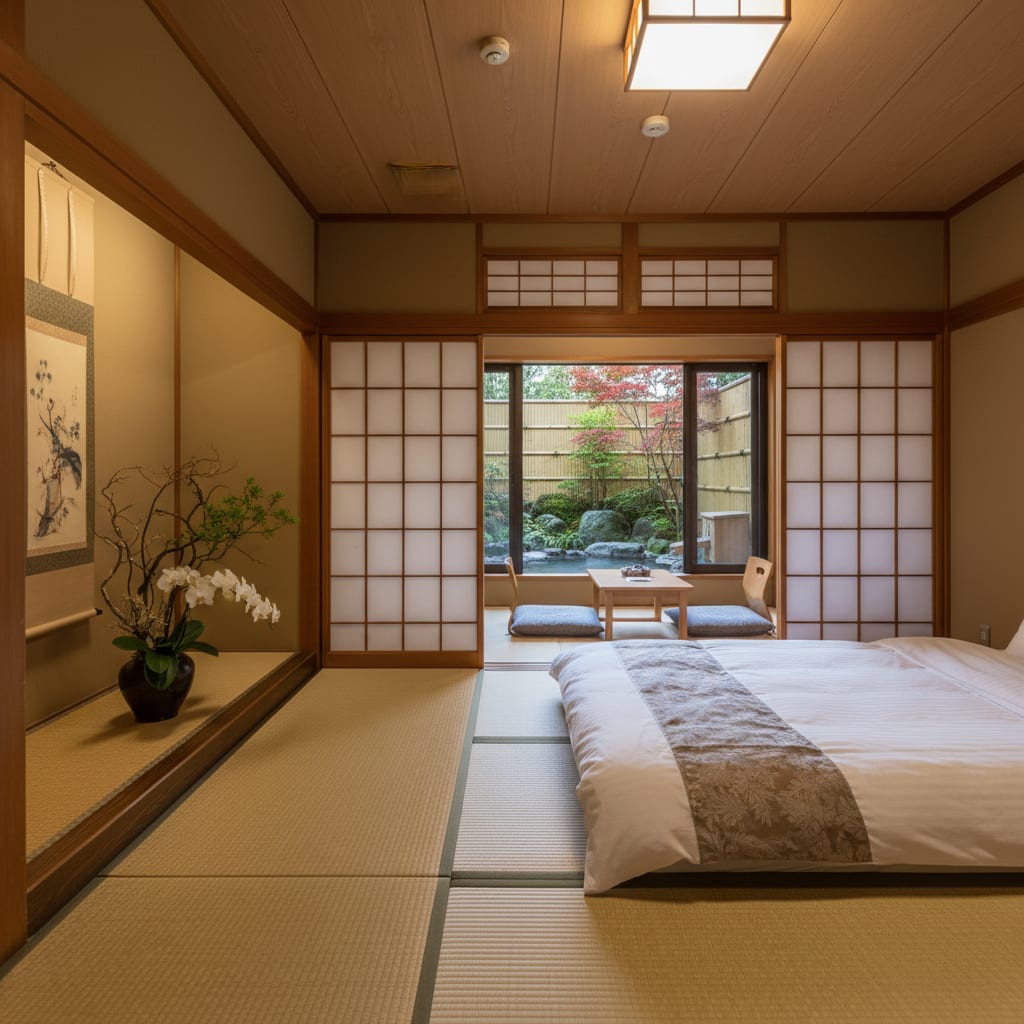
Keep it bare: a flat cushion, perhaps a stone lantern nearby, nothing else. The corner should ask nothing of you — that’s what makes you return to it.
Decor tips:
- Palette: honeyed timber, charcoal frame, natural linen cushion.
- Materials: smooth-planed cedar or larch decking; a single stone lantern (tōrō).
- Lighting: one candle-warm lantern glow — 2200–2700K, low and shielded.
- Hero piece: the platform edge itself, perfectly clean and shadow-lined at dusk.
Zen in a small backyard or courtyard
No space is too small — Japan perfected the tsubo-niwa, a complete courtyard garden in a few square metres. A 2x2m gravel bed, three stones, a fern and a lantern is a genuine zen garden. In tight spaces the rules tighten too: fewer elements, more emptiness, and one strong view from the window or door that frames it like a painting.
This is exactly where previewing pays off. Upload your courtyard photo, generate the zen version, and check the composition from the window you’ll actually see it through — then browse the wider Themed Worlds if you want to compare it against other garden directions, or carry the same calm indoors with the Japandi entry in the base styles.
How to get the look on your own backyard
- Take one clear daylight photo from the spot you view the garden most — a back door or kitchen window — with the boundaries and ground plane in frame.
- Open the Zen Garden world in Architectural AI, or type a custom prompt like “dry zen garden, raked gravel, three granite stones, moss, stone lantern”.
- Upload the photo — the AI redesigns your actual garden, keeping its real shape, fences and light.
- Iterate: try a version with a water basin and one without; shift the emphasis from gravel to moss; compare morning and evening moods.
- Save the winning design to your gallery and use it as the build plan — you’ll know where every stone goes before you lift one.
Frequently Asked Questions
What do you need for a backyard zen garden?
The core kit is simple: an area of fine gravel or sand you can rake, a small odd-numbered group of natural stones, restrained evergreen planting such as moss, ferns or a clipped pine, and ideally one quiet water element. Emptiness is a feature, not a gap to fill.
What is the point of raking gravel in a zen garden?
The raked patterns represent water — ripples around stones, waves across open space — and the act of raking itself is a moving meditation. Visually, the parallel lines give the garden calm, ordered texture.
Can I make a zen garden in a small backyard?
Yes — the Japanese tsubo-niwa tradition creates complete zen courtyards in just a few square metres. A 2x2m gravel bed, three stones and one lantern is a genuine zen garden, not a compromise.
How do I see what a zen garden would look like in my backyard?
Take one daylight photo of your garden and upload it to Architectural AI’s Zen Garden world. The AI redesigns your actual space — same boundaries, same proportions — with raked gravel, stone and moss, so you can judge the layout before moving a single rock.
What plants belong in a zen garden?
Stay evergreen and structural: moss, ferns, clipped pines or box balls, bamboo for screening, and a single Japanese maple for seasonal colour. Avoid busy flower beds — restraint is what keeps the garden calm.
Begin with one photo
A zen garden is the rare project where the shopping list gets shorter as the design gets better. Decide with your eyes first: take one photo of your backyard, open the demo, and see the raked-gravel version of your own garden in seconds. The calm starts before the first stone arrives.
Keep reading