Art Nouveau Salon Ideas: Whiplash Curves, Stained Glass and Belle Époque Warmth
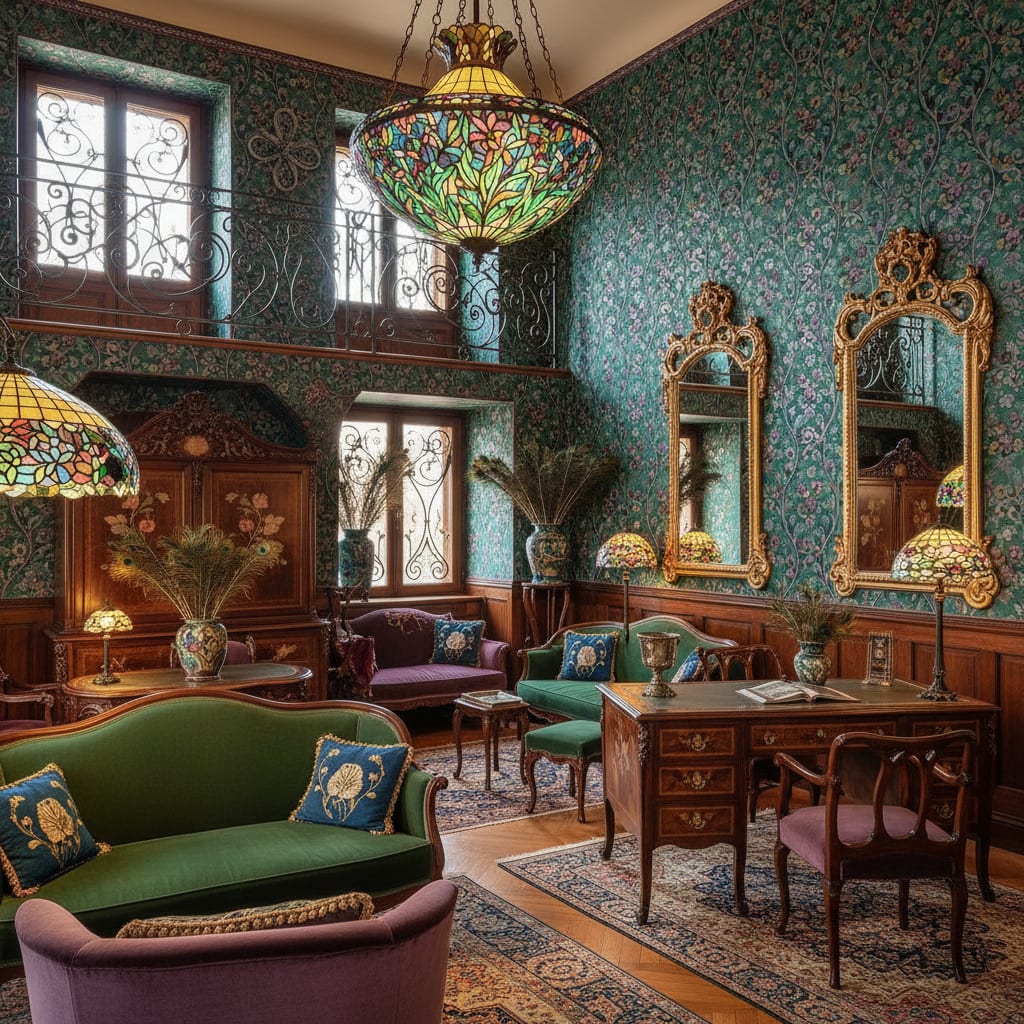
Art Nouveau is one of the most recognisable interior styles and one of the least often executed well, because it’s easy to grab the ornament and miss the underlying idea. The ornament without the idea is pastiche. The idea is worth understanding first.
The whiplash line
Everything in Art Nouveau descends from one principle: the organic, asymmetrical curve drawn from nature — plant stems, vines, insect wings, flowing hair. Designers called it the whiplash line.
It’s not a decorative motif applied to objects. It’s the structure of the objects. A Hector Guimard Métro entrance isn’t an iron frame with plant decoration on it; the iron is the plant. A Louis Majorelle cabinet’s legs grow rather than stand.
Practically, this tells you what to look for: furniture and fittings whose shape curves, not just whose surface is decorated. One genuinely sinuous piece does more than a dozen floral cushions.
The palette: muted, warm, botanical
Art Nouveau colour is drawn from plants in shade rather than in sun:
- Moss and olive green — the backbone.
- Mustard, ochre, and amber.
- Plum, aubergine, and dusty rose.
- Peacock blue and teal.
- Warm woods — walnut, mahogany, oak — and wrought iron in near-black.
Note what’s absent: bright white, cool grey, primary colours, and high contrast. A modern room repainted moss green with walnut furniture is already halfway to the register before a single motif appears.
Stained and leaded glass
The second signature. Light passing through coloured glass is the atmospheric core of an Art Nouveau salon, and it’s also the most accessible entry point.
In descending order of commitment:
- A leaded or stained glass panel in a door, an internal window, or a cabinet front.
- A Tiffany-style lamp — the single most efficient purchase in this style.
- Stained-glass window film on an existing window. Inexpensive, reversible, and surprisingly convincing when the light hits it.
- A framed glass panel hung in front of a window rather than fitted into it.
Botanical motifs and wall treatment
Walls in an Art Nouveau interior are rarely plain. The options:
- Botanical wallpaper — stylised lilies, irises, poppies, wisteria, and whiplash tendrils. Morris & Co-adjacent patterns work well.
- A frieze band at picture-rail height, leaving the wall below plain. This is the restrained version and it’s often the better one in a modern room.
- A stencilled border around a door or window opening.
- Carved or applied wood in curved organic forms around openings.
One patterned wall with three plain walls in a deep tone is the modern-compatible approach. All four walls in a strong botanical print requires ceiling height and confidence.
Furniture and joinery
- Curved, sinuous frames — a chair whose back sweeps, a cabinet whose sides bow.
- Marquetry in floral or landscape scenes.
- Rich upholstery: velvet, brocade, or a botanical woven print.
- Built-in seating — the settle or inglenook was central to the period.
- A chaise longue or an asymmetric sofa as the statement.
If a full period piece is out of reach, look for modern furniture with genuinely organic form — the shape matters more than the age.
Lighting: amber and low
Art Nouveau interiors were lit by early electric and gas light, which means warm, low, and glowing rather than bright:
- 2200–2700K bulbs throughout, on dimmers.
- Tiffany-style or opaline glass shades that glow rather than shine.
- Wall sconces with curved iron arms — the plant-stem form again.
- Uplighting through glass and up walls to catch texture.
Never a bright ceiling flood. The whole style depends on shadow and glow.
Metalwork and hardware
Wrought iron and brass in curved, organic forms — a stair balustrade, a fire screen, curtain rods with leaf finials, door handles that swirl. Hardware is a disproportionately cheap way into this style because a set of Art Nouveau-style handles changes an entire cabinet.
Art Nouveau vs Art Deco — getting them the right way round
These get confused constantly, and they’re opposites:
| Art Nouveau (1890–1910) | Art Deco (1920s–30s) | |
|---|---|---|
| Line | Organic, asymmetrical curve | Geometric, symmetrical |
| Source | Plants, nature | Machines, speed, ancient Egypt |
| Palette | Muted earth tones | High contrast, black/white/gold |
| Materials | Wood, iron, stained glass | Chrome, lacquer, mirror, exotic veneer |
| Feeling | Handmade, growing | Manufactured, precise |
If you’re after the geometric version, our Art Deco world and Old Hollywood glamour guide are the right places to look instead.
The modern-compatible version
Full Art Nouveau is a heavy style for a contemporary flat. The three-element approach works better:
- One curved statement piece — a chair, a mirror, a light fitting.
- One glass element — a Tiffany-style lamp is the easiest.
- One botanical surface — a papered wall, or a frieze.
Add a warm dimmed light layer and a deep-toned wall, and the register is unmistakable without the room becoming a museum. For the period context more broadly, the 1900s Edwardian Art Nouveau world shows the full-commitment version.
Preview it before you commit to moss green
Deep warm tones and patterned walls behave very differently depending on natural light — glorious in a bright room, oppressive in a dark one. That’s exactly what’s worth testing first.
With Architectural AI, photograph your living room and restyle it as the Art Nouveau Salon or the Art Nouveau Paris Salon in seconds, on your real walls and windows. Start in the demo, browse the worlds catalog, or ask our AI designer about your particular room.
The bottom line
Art Nouveau lives in the curve, not the flower. One sinuous piece of furniture, one piece of coloured glass, one botanical surface, and warm amber light will carry the style further than a room full of period-print cushions. Get the line right and the ornament becomes optional.
Download Architectural AI and see your salon in Belle Époque dress.
FAQ
What is Art Nouveau interior design? Art Nouveau is a decorative style from roughly 1890 to 1910 built on organic, asymmetrical curves drawn from nature — the so-called whiplash line. Interiors feature botanical and insect motifs, stained and leaded glass, carved sinuous woodwork, wrought iron, and a warm palette of moss green, mustard, plum and amber.
What is the difference between Art Nouveau and Art Deco? Art Nouveau (1890–1910) is organic, asymmetrical and curved, drawn from plants and natural forms, in muted earthy tones. Art Deco (1920s–30s) is geometric, symmetrical and machine-inspired, in high-contrast colours with chrome and lacquer. They are close in date and opposite in logic.
How do I add Art Nouveau to a modern living room? Pick three elements rather than committing to the whole style: one curved statement piece of furniture, one stained or leaded glass element such as a Tiffany-style lamp or a window film, and a botanical wallpaper or frieze on a single wall. Add warm amber lighting and the register lands without the room becoming a period recreation.
Can I preview an Art Nouveau style on my own room? Yes. Architectural AI includes Art Nouveau Salon and Art Nouveau Paris Salon worlds that restyle a photo of your real living room into the Belle Époque look in seconds, letting you test the dark warm palette against your own light before repainting or buying furniture.
Keep reading