What Size Rug for a Living Room (and Every Other Room)
Most rugs in most living rooms are one size too small. It is the most common furnishing mistake there is, and it is an expensive one, because a rug is the one thing you cannot fix by shoving it somewhere else. The good news is that rug sizing is arithmetic, not taste. Here are the numbers.
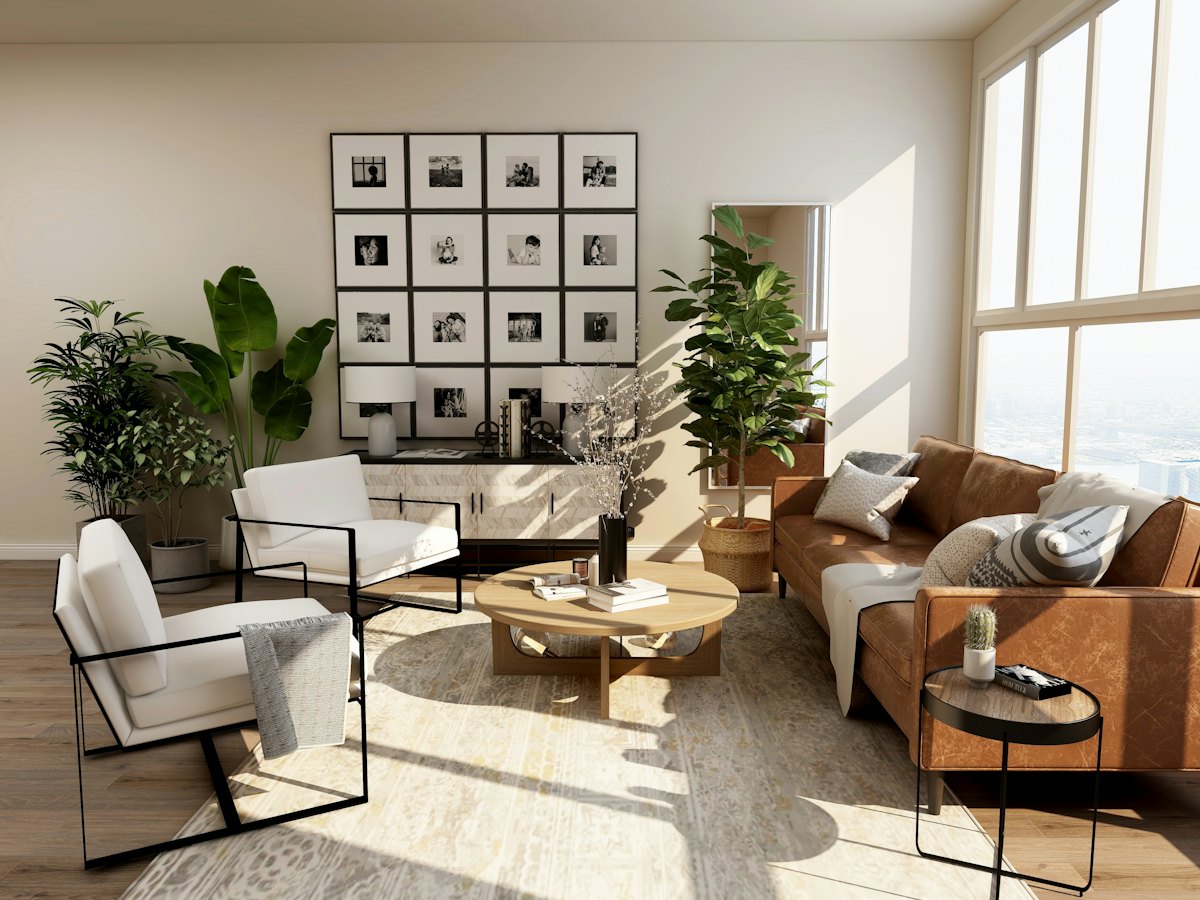
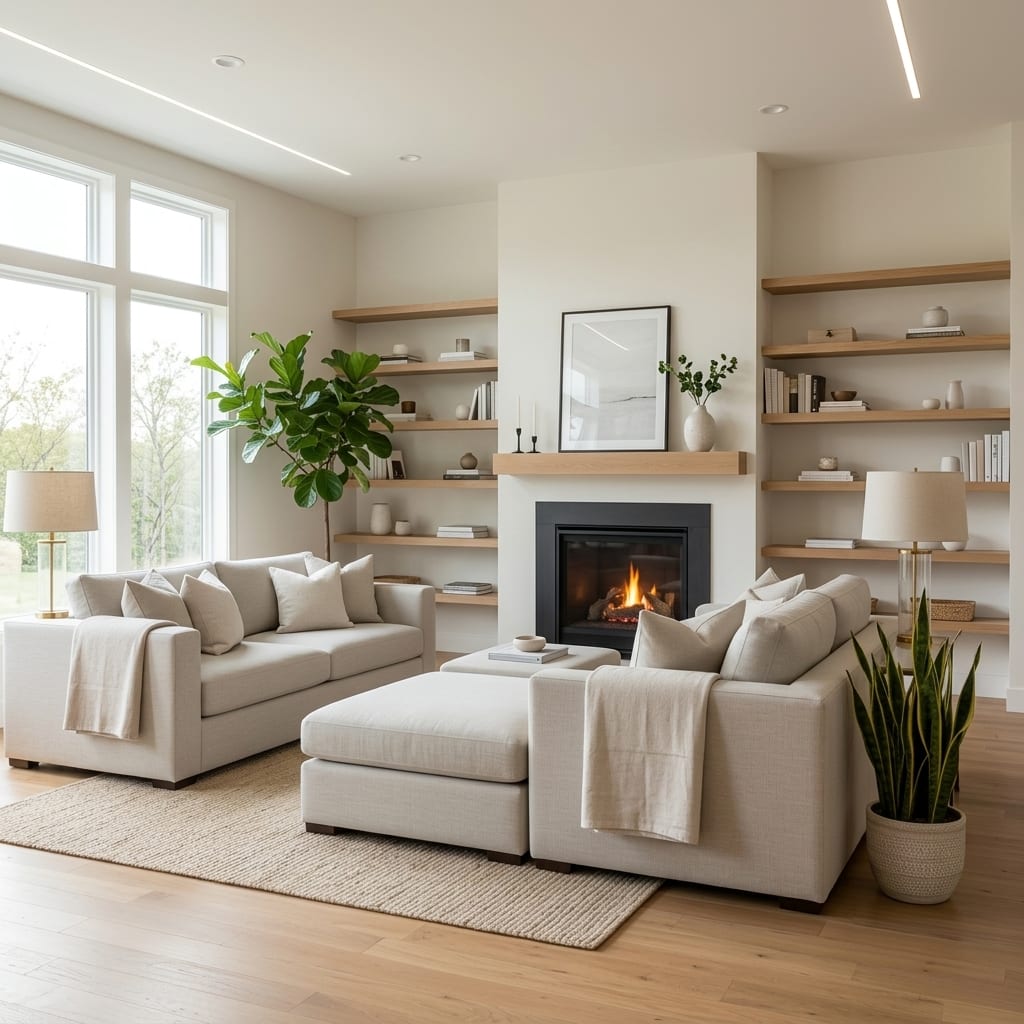
For a standard living room, buy a rug at least 30 cm (12 in) wider than the sofa at each end, and get the front legs of every seat onto it. For most three-seat sofas that means 240x340 cm (8x10 ft); a 200x290 cm (6x9 ft) only works in rooms under about 18 m2. Leave 40–45 cm of bare floor at the walls.
The three placements, and why floating usually looks wrong
All legs on. Every leg of every seat sits fully on the rug, and the rug still extends past the furniture. It reads calm and deliberate, and it is the only placement that makes a room feel like a hotel lobby in a good way. It also needs a rug roughly 60 cm longer and 60 cm deeper than the entire seating group, which in a normal flat means 300x400 cm and up. Most people find out the price and stop here.
Front legs on. The rug slides 20–30 cm under the front of the sofa and each armchair; back legs stay on the floor. This is the sensible default. It gives you the visual anchoring of a big rug for one size down, and it is very forgiving of a sofa that is not quite parallel to the wall. The rug still has to be wider than the sofa is long — that part is not optional.
Floating. Nothing touches the rug except the coffee table. This is the one you see in photos of small flats, and it almost always looks wrong. Two rectangles — the rug and the seating group — sit near each other without agreeing, and the eye reads them as unrelated. It also makes the room look smaller, because the floor is visually chopped into pieces instead of one plane.
There are two cases where floating is fine: a single reading chair and a side table sitting fully on a 120x170 cm, and a round rug under a round table. If you are floating anyway, keep the rug at least as long as the sofa and leave no more than 25 cm of bare floor between the rug edge and the sofa front. Beyond that gap it stops reading as one group.
Living room rug size, by sofa and by room
Sofa length is the number that decides it. Measure end to end, over the arms, not the seat cushions.
| Sofa length | Minimum rug width | Metric size | US size | Placement it supports |
|---|---|---|---|---|
| up to 160 cm / 63 in | 220 cm / 87 in | 160x230 | 5x8 | front legs on |
| 180–210 cm / 71–83 in | 270 cm / 106 in | 200x290 | 6x9 | front legs on |
| 210–240 cm / 83–94 in | 300 cm / 118 in | 240x340 | 8x10 | front legs on |
| 240–280 cm / 94–110 in | 340 cm / 134 in | 300x400 | 9x12 | all legs on |
| L-shape or corner sofa | longest arm + 60 cm | 300x400 | 9x12 or 10x14 | front legs along both arms |
Cross-check against the room, because a rug that is correct for the sofa and wrong for the room still looks wrong.
| Living room area | Metric size | US size | Note |
|---|---|---|---|
| under 12 m2 / 130 sq ft | 160x230 | 5x8 | border can drop to 20 cm |
| 12–18 m2 / 130–195 sq ft | 200x290 | 6x9 | the most-sold size for a reason |
| 18–25 m2 / 195–270 sq ft | 240x340 | 8x10 | the size most people should buy and don’t |
| 25–35 m2 / 270–375 sq ft | 300x400 | 9x12 | all legs on becomes realistic |
| over 35 m2 or open plan | 300x400 plus a second rug | 9x12 plus 5x8 | one rug per zone, not one giant rug |
Then the border. Leave 40–45 cm (16–18 in) of bare floor between the rug edge and the wall. Under 12 m2 you can go down to 20 cm; over 30 m2, push to 60 cm. What matters more than the exact figure is that the border is even on the sides you can actually see. A 20 cm gap on one side and a 50 cm gap on the other looks like an accident from across the room, even to people who could not tell you why.
If your maximum (wall to wall, minus two borders) comes out smaller than your minimum (sofa plus 60 cm), you do not have a size problem — you have a layout problem. Our guide to furniture arrangement rules covers the clearances, and living room layout ideas covers what to do when the room is genuinely too narrow.
Dining rooms: 60 cm past the table on every side
This is not a proportion rule, it is a chair-leg rule. A dining chair travels 50–55 cm backwards when someone stands up. If the back legs drop off the rug edge, the chair tips, the sitter grabs the table, and over a year the binding on that edge is destroyed. So: 60 cm (24 in) of rug past the table on all four sides, or 75 cm if the chairs have arms and people push out further.
| Table | Seats | Rug needed | Buy (metric) | Buy (US) |
|---|---|---|---|---|
| 120x80 cm | 4 | 240x200 cm | 200x290 | 6x9 |
| 140x90 cm | 4–6 | 260x210 cm | 240x340 | 8x10 |
| 160x90 cm | 6 | 280x210 cm | 240x340 | 8x10 |
| 180x90 cm | 6–8 | 300x210 cm | 240x340 | 9x12 |
| 200x100 cm | 8–10 | 320x220 cm | 300x400 | 9x12 |
| round, 120 cm dia. | 4 | 240 cm dia. | round 240–250 | 8 ft round |
| round, 140 cm dia. | 6 | 260 cm dia. | round 300 | 9 ft round |
Keep the pile at 6 mm or under — a flatweave, ideally. Chairs have to slide, and a chair leg catching on a 20 mm pile is how dining rugs get torn. More on the room itself in our dining room design guide.
Bedrooms, by bed size
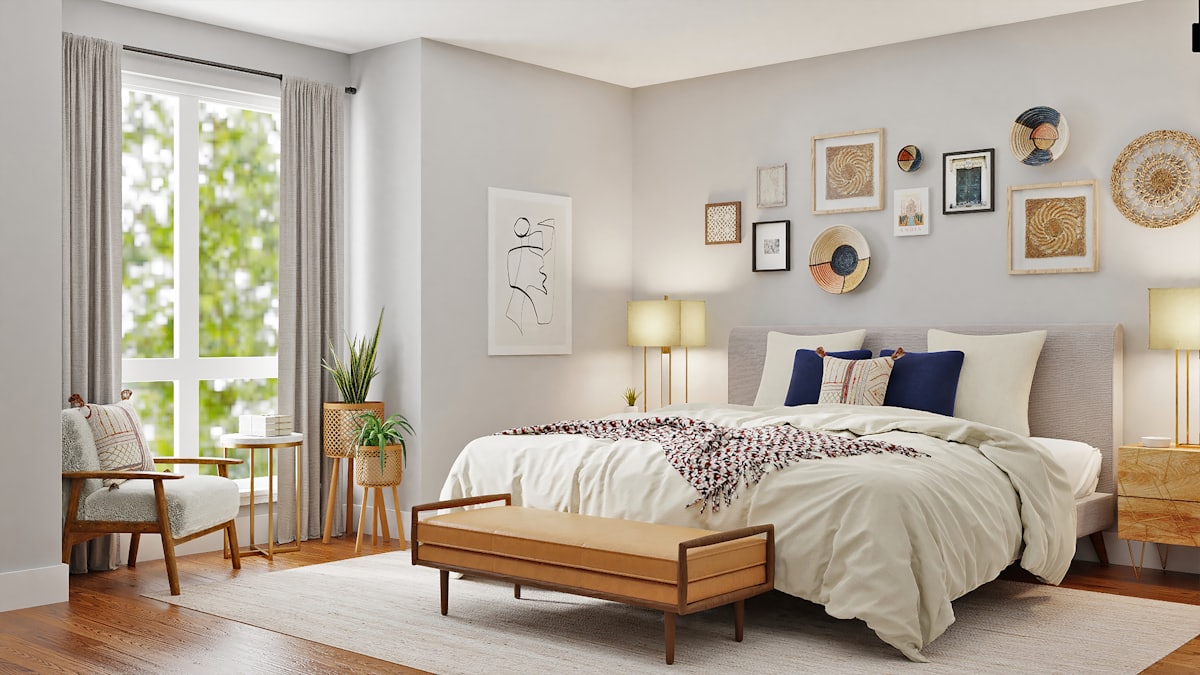
There are two placements worth doing: the rug runs under the whole bed and out past it, or it starts about 60 cm down from the headboard so it clears the nightstands. Either way you want 60 cm (24 in) of rug visible on each side and at the foot. Forty-five is the absolute floor; below that it reads as a bath mat.
| Bed | Size (EU / US) | Rug under the whole bed | Rug from below the nightstands | Runner option |
|---|---|---|---|---|
| Single / twin | 90x200 / 97x191 cm | 200x290 (6x9) | 160x230 laid across | one 80x200 |
| Double / full | 140x200 / 137x191 cm | 240x340 (8x10) | 200x290 laid across | two 80x250 |
| Queen | 160x200 / 152x203 cm | 240x340 (8x10) | 200x290 laid across | two 80x250 |
| King | 180–200x200 / 193x203 cm | 300x400 (9x12) | 240x340 laid across | two 80x300 |
The runner version is underrated in small bedrooms. Two 80x250 cm runners, one each side, cost less than one 240x340, and they put wool exactly where your feet land in February. They also survive a house move into a room of a completely different size.
Runners: hallways, kitchen galleys and stairs
- Hallway 100–120 cm wide: runner 70–80 cm. Leave 10–15 cm of bare floor on each side. Stop the runner 15–20 cm short of the wall at each end, and outside the arc of every door.
- Galley kitchen: 60–80 cm wide, 6 mm pile maximum, and machine washable or it will not last a year. Between a counter and an island, keep the walking gap at 100–120 cm and centre the runner in it.
- Stairs: 65–75 cm on a standard 90 cm stair, leaving 7–12 cm of tread showing on each side.
- Lengths actually stocked: 80x200, 80x250 and 80x300 cm in Europe; 2.5x8 ft and 2.5x12 ft in the US. For a corridor longer than 3 m, two runners with a 10 cm gap look better than one stretched-looking custom cut.
Layering, pile height, and doors that have to open
Layering is the cheapest way to get a big rug look. Put a flatweave jute or sisal base down, 40–60 cm bigger in each direction than the top rug, so about 20–30 cm of the base shows as a border on every side. The base does the sizing job; the top rug does the pattern job. If the top rug is less than 40 cm smaller in each dimension, the border is too thin to read as intentional.
Pile heights, for reference: flatweave up to 6 mm, low pile 7–12 mm, medium 13–20 mm, shaggy 25–50 mm.
Now the thing that catches people out. A standard interior door clears 8–12 mm above the finished floor. Your rug pad is 3–5 mm of felt. So a 12 mm pile plus a 4 mm pad under a door swing means the door stops dead, and shaving the bottom of a rented flat’s door is not a decision you get to make. Either keep the total stack under 10 mm where the door sweeps, or hold the rug edge 5 cm outside the door arc. Underfloor heating adds one more constraint: low pile and no solid rubber backing, which traps heat under the rug.
Tape it out before you order
- Measure the sofa end to end, over the arms. Add 60 cm. That is your minimum rug width.
- Measure wall to wall. Subtract 80–90 cm for a border on each side. That is your maximum.
- If the maximum is under the minimum, accept front legs on and stop trying to make all legs on happen.
- Mask both candidate sizes on the floor with painter’s tape — the full rectangle, not just the corners. Corners lie.
- Open every door that swings over the area. Pull the dining chairs out. Walk the route you actually walk at 7am.
- Leave the tape down for two days. If you keep clipping the same corner, the rug is in the wrong place, not the wrong size.
- Order the pad at the same time, cut 2–3 cm smaller than the rug on every side so it never peeks out.
What this doesn’t fix
A rug cannot repair a layout. If the sofa is three metres from the armchairs, no amount of wool pulls that group together — see how to change a room layout instead. Pattern scale is its own trap: a large medallion on a 160x230 reads as noise, so check the repeat size, not just the colour. Screen colour is unreliable; order a sample if the shop offers one. And measure around radiators, floor vents and door thresholds before you commit, because those are the three things nobody remembers until the delivery arrives.
The other honest limit is on previewing. You can photograph your room and see what a pale flatweave does versus a dark wool one, which genuinely settles the colour and pattern argument fast — Architectural AI does exactly that on a photo of your own room. What it cannot do is measure. It renders a look, not a plan; it has no idea how wide your room is. Settle colour and pattern on screen, settle size with tape.
Once the rug is right, the two things that most change how finished a room looks are curtain height and what is on the walls — see the curtain length and hanging guide and the gallery wall guide. In a small flat, the border rule is doing even more work than usual; small apartment design ideas has the rest of that argument.
FAQ
What size rug do I need for my living room?
Measure your sofa end to end including the arms, then add 60 cm (24 in). That is the minimum rug width. A 210–240 cm three-seat sofa therefore needs a rug at least 270–300 cm wide, which in practice means 240x340 cm or 8x10 ft. A 200x290 cm or 6x9 ft rug only works with sofas up to about 210 cm, in rooms under roughly 18 square metres.
Should all the furniture be on the rug?
Not necessarily. There are three accepted placements. All legs on looks calmest but needs a rug bigger than most rooms allow. Front legs on, where the rug slides 20–30 cm under the front of every seat, is the most forgiving and the one to default to. Floating, with only the coffee table on the rug, almost always looks like a mistake because the rug stops relating to the furniture.
How much floor should show around a rug?
Aim for 40–45 cm (16–18 in) of bare floor between the rug edge and the wall in a normal room. In a room under 12 square metres you can drop to 20 cm, and in a room over 30 square metres go up to 60 cm. Evenness matters more than the exact figure — a 20 cm border on one side and 50 cm on the other is instantly visible.
What size rug goes under a dining table?
The rug must extend 60 cm (24 in) past the table edge on all four sides, or 75 cm if the chairs have arms. A dining chair travels 50–55 cm backwards when someone stands, and a back leg dropping off the rug edge tips the chair and shreds the binding. A 160x90 cm table needs at least 280x210 cm, so buy 240x340 cm or 8x10 ft.
What size rug for a queen bed?
A queen bed is 160x200 cm in Europe and 152x203 cm in the US. To run the rug under the whole bed with 40 cm showing each side and 70 cm at the foot, buy 240x340 cm or 8x10 ft. If you prefer the rug to start below the nightstands, a 200x290 cm laid across the room works, or use two 80x250 cm runners, one each side.
Is a 5x8 rug too small for a living room?
For a full seating group, yes, in almost every case. A 5x8 ft rug is 152x244 cm, which is narrower than many three-seat sofas are long. It works as a rug for a single armchair and side table, under a small coffee table in a studio, or at the foot of a single bed. In a living room it reads as a floor tile rather than a zone.
Keep reading