The Two-Square-Meter Office: Desk Corners That Actually Work
The best place for a desk in a small home is rarely a spare room — it’s the two square meters your apartment is currently wasting. A corner, the end of a hallway, a deep windowsill, the slice of wall behind a door, or a cleared-out closet will all hold a real workspace if you build up instead of out. The trick for remote workers on tight square footage is to find that dead pocket, go vertical for storage, and preview the desk in place before you buy the wrong size.
Why do small-space offices fail?
Most compact setups don’t fail because the room is too small. They fail because people try to shrink a full office — big desk, filing cabinet, second monitor arm, printer — into a space that was only ever going to hold a laptop and a lamp. A small space desk ideas approach starts from the opposite direction: what’s the least furniture that lets you do focused work, and where can it disappear into the room’s unused edges?
The other quiet failure is clutter creep. In a small space there’s no drawer to hide the mess in, so cables, chargers, and paper pile up in the open and the corner starts to feel like a junk zone instead of a workspace. Solving storage and cable routing up front is what keeps a two-square-meter office feeling deliberate.
Where are the best desk-corner candidates?
Walk your home and look for pockets the room isn’t using. The strongest candidates:
- An empty corner. A corner desk turns two walls of otherwise dead space into a workstation and naturally gives you depth behind you for calls.
- The end of a hallway. A shallow desk against the far wall of a hall reclaims pure circulation space.
- A wide windowsill or under a window. Natural light in front of you, and the sill can hold plants or a lamp.
- An unused or half-used closet (“cloffice”). Remove the door, add a surface and a light, and close it off at the end of the day.
- Behind a door that’s usually open. The wall a swung-open door covers is invisible dead space that a slim desk fits perfectly.
If none of those jump out, our guide to dead space ideas at home is built entirely around spotting these forgotten pockets and turning them into something useful.
How much space does a desk actually need?
Less than most people assume. A comfortable working footprint is roughly 100–120 cm of width and 50–60 cm of depth, plus about 60–70 cm behind it for the chair to pull out. But in a genuinely tight corner you can drop to a 40 cm-deep wall-mounted or floating desk — enough for a laptop, a notebook, and a coffee — and reclaim the floor entirely.
A quick sizing reality check before you shop:
| Setup | Desk width | Desk depth | Best for |
|---|---|---|---|
| Laptop only | 80–100 cm | 40–50 cm | Hallways, closets, behind-door nooks |
| Laptop + monitor | 110–120 cm | 55–60 cm | Corners, under windows |
| Dual monitor | 140 cm+ | 60 cm | Needs a dedicated wall, not a tight nook |
Measure your pocket before you fall in love with a desk online. The number one small-space regret is a desk that technically fits the wall but blocks a drawer, a radiator, or the chair’s path.
How do you get storage without floor space?
In a small office the rule is simple: build up, not out. The floor is for your chair and your feet, and nothing else.
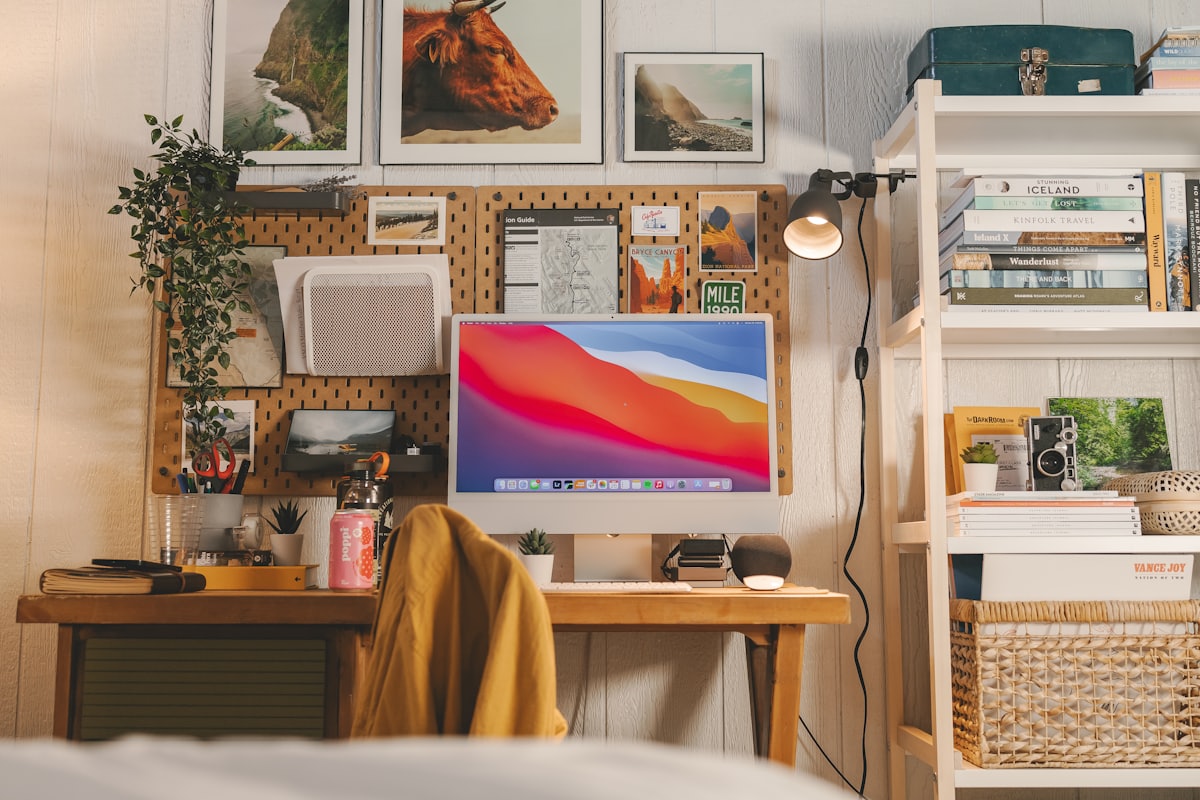
- Float two or three shelves above the desk for books, a plant, and a small basket that swallows the daily clutter.
- Use a pegboard or rail on the wall for headphones, cables, and stationery so the desktop stays clear.
- Add a slim rolling cart that tucks under or beside the desk and rolls away when you need the room back.
- Choose a desk with one shallow drawer rather than a separate filing cabinet.
Vertical storage is also what lets a workspace share a room without taking it over — the same principle behind most small apartment design ideas, where every surface earns its keep.
What is “cable sanity” and why does it matter here?
Cable sanity is a single, tidy route for every wire so power and charging never end up as a visible tangle. In a large office you can hide cables in a drawer or under a big desk; in two square meters, exposed cables are right at eye level and instantly make the whole setup look temporary and chaotic.
The fix is quick and cheap: mount a power strip under the desktop or on the wall behind it, gather every cable into one sleeve or channel running to that strip, and get the charger bricks off the floor. Give yourself enough slack to move the laptop, but no more. One clean cable route does more for how “finished” a small desk looks than any decor.
How do you preview a desk before you buy the wrong one?
This is where small spaces punish guesswork the hardest — a returned desk is a hassle, and a desk that doesn’t fit is money and a Saturday gone. Rather than eyeballing it, photograph the corner and mock it up first. With Architectural AI you can upload a shot of the empty pocket and see a desk, shelving, and styling dropped into that exact spot in about ten seconds, then compare a few layouts on the before/after slider.
A practical way to use it:
- Photograph your top two or three candidate pockets straight-on.
- For each, generate a furnished version so you can judge scale and how much the room breathes.
- Test one vertical-storage direction (shelves above) against one closed-storage direction.
- Pick the pocket and layout that read best, then shop to those exact dimensions.
You can run this on your own corners in the demo before committing to a single purchase, and browse design styles to find a look that keeps the nook feeling calm rather than crowded.
A two-square-meter office checklist
- Pocket chosen from unused space, not stolen from where you walk.
- Desk measured to fit with the chair pulled out and drawers/radiators clear.
- Storage goes up the wall; the floor stays clear.
- One tidy cable route to a single power strip.
- Something soft or green (a plant, a small rug) so it reads as a room, not a workstation.
- Previewed in place before anything was ordered.
The bottom line
You don’t need a spare room to work well from home — you need to see the two square meters your apartment is wasting and build a proper little office into it. Find the dead pocket, size the desk honestly, send the storage up the wall, tame the cables, and preview the whole thing before you buy. Done right, a corner can out-work a room twice its size.
Ready to find your desk corner? Download AI Room Redesign: Home Decor on the App Store, photograph the empty pocket, and see a working desk in place before you order a thing.
FAQ
Where can I put a desk in a small apartment? The best candidates are an underused corner, the end of a hallway, a wide windowsill, an unused closet, or the slice of wall behind a door. Look for two square meters the room isn’t already using.
How much space does a home office desk really need? A workable desk footprint is about 100–120 cm wide by 50–60 cm deep, plus room for a chair to slide out. In tight spaces, a 40 cm-deep wall-mounted or corner desk is enough for a laptop setup.
How do I hide cables in a small desk setup? Mount a power strip under or behind the desk, run cables through a single channel or sleeve, and keep the charger brick off the floor. One tidy cable route is what makes a compact desk read as intentional rather than temporary.
Can I preview a desk in my corner before I buy it? Yes. Photograph the corner and use an AI redesign app to mock up a desk, shelving, and styling in that exact spot so you can confirm the fit before ordering.
Keep reading