Curtain Length and Hanging Height: The Numbers
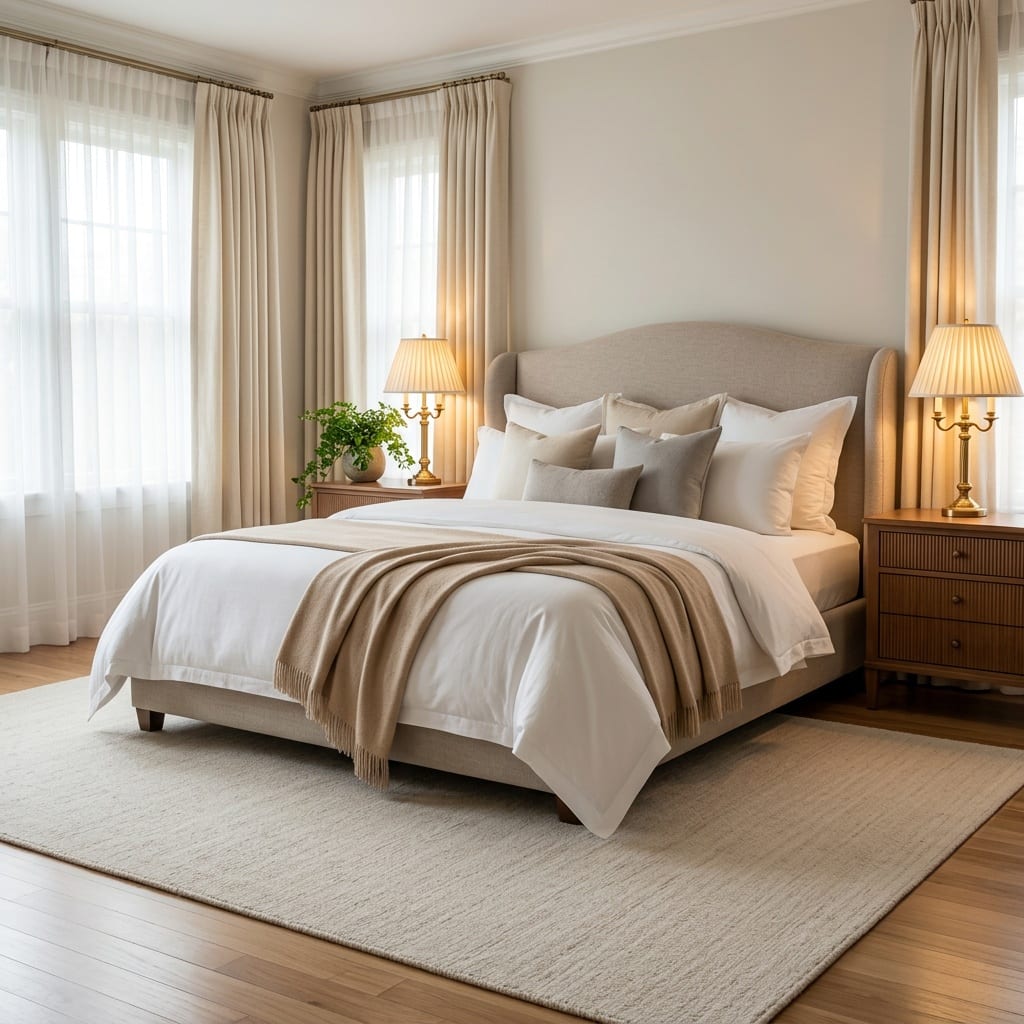
Most curtains in most homes are hung too low, too narrow and too short. The rod goes straight onto the frame, the hem stops 6 cm above the floor, and two thin panels get stretched across a 220 cm rod so they never actually close. Each of those is a measuring decision, and each of them has a number attached.
Hang the rod 10–20 cm (4–8 in) above the window frame, or 5–10 cm (2–4 in) below the ceiling when you want the room to read taller. Extend it 15–25 cm (6–10 in) past the frame on each side. Buy panels totalling at least 1.5× the rod width, and 2× if you want them to look properly full.
How high above the frame
The gap between the top of the frame and the underside of the rod decides how tall the window looks. Ten centimetres is the minimum that reads deliberate. Twenty is the sweet spot on a standard 250 cm ceiling.
Then there is the rule that overrides all of it: if the wall above your frame is shorter than about 30 cm, don’t split the difference. Take the rod to 5–10 cm below the ceiling or the underside of the cornice. A stub of exposed wall above a rod looks like an accident; a rod tight to the ceiling with a floor-length panel below it draws one clean vertical from ceiling to skirting, and the room gains 15–25 cm of apparent height for the price of two brackets moved.
Two cases where you should not go to the ceiling: a deep decorative cornice you’d be covering, and a sloped or dropped ceiling section where a ceiling-mounted track ends up visibly out of parallel with the window.
How far past the sides
Rod width = window width + 30 to 50 cm. That is 15–25 cm of overhang per side, and it exists for one reason: stacking.
A pair of open curtains has to physically go somewhere. If the rod stops at the frame, they go onto the glass, and a lined pair eats 20–25 cm of daylight on each side without you noticing. Give them wall to stack on and you keep the light, and the window reads roughly 40 cm wider than it is. This matters most in a room that already feels dim — a dark rental usually loses more light to badly hung curtains than to the window size.
Heavy interlined panels or a wide patio door want 25–30 cm per side. If the wall runs out before you get there, mount to the ceiling and run the track past the frame as far as the wall allows.
Float, kiss, puddle
| Length | Gap at the hem | Reads as | Best for | Downside |
|---|---|---|---|---|
| Float | 1–2 cm (½ in) above floor | Clean, current | Daily-use panels, pets, kids, uneven floors | Needs the hem right or it looks short |
| Kiss | 0, just touching | Tailored | Living rooms, formal bedrooms, level floors | Unforgiving; 1 cm out and it either gaps or crumples |
| Puddle | 5–15 cm (2–6 in) on floor | Soft, traditional | Static side panels, tall period rooms | Collects dust, gets vacuumed, gets stood on |
| Sill | 1–2 cm above the sill | Practical | Kitchens, bathrooms | Looks cheap in a living room |
| Apron | 10–15 cm below the sill | Practical | Windows over radiators or units | Awkward proportion on tall windows |
Float is the one I’d pick for almost any curtain you touch every day. Kiss is genuinely better looking, but floors are rarely level and a 2 cm dip across a bay will show up as a hem that hovers at one end and buckles at the other.
Puddle deserves a warning that showrooms never give it. A 10 cm puddle is fabric lying on your floor, permanently, in the path of the vacuum and the dog. It works on a pair of dress panels either side of a window you never close. It does not work on the curtain you drag open at 7 am.
Fullness, and how many panels to buy
Fullness is the ratio of total finished fabric width to rod width. It is the difference between curtains that look full and curtains that look rationed.
- 1.5× — the minimum. Acceptable for sheers and for panels that stay open.
- 2× — the standard for a room you care about.
- 2.5× — heavy or formal headings, and where the panels are the main event.
The arithmetic people skip:
Rod width × fullness ÷ panel width = number of panels.
On a 200 cm rod at 2× fullness you need 400 cm of panel. Standard ready-made panels are around 140 cm wide, so that is three panels, not two. Two panels gives 280 cm, which is 1.4× — flat, stretched, and the reason a lot of new curtains look wrong straight out of the packet.
| Rod width | 1.5× | 2× | 2.5× | Panels needed at 2× (140 cm each) |
|---|---|---|---|---|
| 120 cm | 180 cm | 240 cm | 300 cm | 2 |
| 160 cm | 240 cm | 320 cm | 400 cm | 2–3 |
| 200 cm | 300 cm | 400 cm | 500 cm | 3 |
| 250 cm | 375 cm | 500 cm | 625 cm | 4 |
| 300 cm | 450 cm | 600 cm | 750 cm | 4–5 |
An odd number of panels is fine. Nobody counts them; they see the folds.
Headings, and what each one does to the fold
| Heading | Fullness it wants | Fold | Hangs from | Notes |
|---|---|---|---|---|
| Pencil pleat | 2–2.5× | Many small gathers | Rod, rings or track | Tape is adjustable, so you can tune fullness after buying |
| Eyelet / grommet | 1.8–2× | Deep, even S-waves | Pole only | Easiest to draw; stacks bulky; rod must be ~1 cm thinner than the eyelet |
| Pinch pleat | 2–2.5× | Structured, crisp, stays put | Rings or track hooks | The most tailored; least forgiving of a cheap fabric |
| Wave | 1.8–2.2× | Uniform continuous curve | Wave track only | Needs the matching track; superb on wide runs and patio doors |
| Tab top | 1.5–1.8× | Flat, casual | Pole only | Friction makes it a nuisance to draw daily |
Eyelet panels lose height at the top: the fabric sits a couple of centimetres above the pole rather than below it, which changes how you measure the drop. Wave is the one worth paying for on a 3 m patio door, because it stacks tighter and slides better than anything else on that span.
Blackout, dimout, sheer
Sheer voile filters light and gives daytime privacy only. After dark, with lamps on inside, a sheer hides nothing — worth knowing before you rely on it in a ground-floor flat.
Dimout blocks roughly 85–95% of light. The room goes dark but not black.
Blackout fabric passes no light through the cloth. What it does not do is stop light arriving around it, and this is where most blackout curtains disappoint. To actually get a dark room:
- Rod 15–20 cm above the frame, or on the ceiling.
- Panels overlapping the frame by 15–20 cm on each side.
- The two panels overlapping each other by 5–10 cm in the middle.
- The top closed — a ceiling track, a pelmet, or a wraparound rod that returns to the wall.
Layering sheers under blackout needs a double rod or a double track: the inner sheer rod at 6–8 cm from the wall, the outer blackout rod at 12–15 cm. That 6 cm of separation is what stops the two layers from rubbing.
In a nursery, darkness is only half of it. Any looped cord within reach of a cot is a strangulation risk, so cordless or tensioned safety devices are not optional, and the cot should sit at least a metre from the window and any cord. There is more on that layout in the nursery and baby room guide; for the adult version, see calming bedroom ideas for better sleep.
How to measure, in order
- Fit the rod first, then measure. Every drop measurement depends on where the rod ends up, so bracket it before you buy fabric. Mark bracket positions 10–20 cm above the frame and 15–25 cm out from each side, and check level with a spirit level rather than the frame — window frames are often out.
- Measure the rod, not the window. Width is measured between the finials, along the part the rings can travel.
- Measure the drop from the right point. Rings on a pole: from the bottom of the ring eye where the hook sits. Track: from the top of the track. Eyelet panels: from the top of the pole, then add 2–3 cm for the fabric that rises above it.
- Take the drop at three points — left, centre, right. Floors dip. Use the shortest measurement, then subtract for the length you want: 1–2 cm for float, 0 for kiss, add 5–15 cm for puddle.
- Check the bracket projection. Standard brackets hold the rod 8–12 cm from the wall. You need more if there is a deep sill, a window handle, a radiator, or a second rod behind. Measure from the wall to the furthest thing sticking out and add 3 cm.
- Then do the fullness sum from the table above and buy the panel count it gives you.
The awkward windows
Radiator under the window. Full-length curtains over a working radiator send the heat straight up the glass. Go sill length, hemmed to finish 1–2 cm above the sill, or apron length 10–15 cm below it. If you want floor-length for looks, accept that you are trading heat for it, or fit a shelf above the radiator to deflect warm air into the room.
Sliding or patio doors. Stack space is not optional here: 25–30 cm of wall past each side, or the open panel blocks the door you use. Float length, 1–2 cm, because anything longer gets stood on. Wave heading on a track beats eyelets on a pole for a 2.5 m-plus panel.
Bay windows. Either a bendable bay track, or three separate rods with returns into the reveal. The thing to check before buying anything is whether the bay corners give you enough dead wall for the panels to stack. Often they don’t, and the honest answer is blinds inside each reveal plus one pair of dress curtains across the front of the bay.
Corner windows. Two rods that meet at 90° will collide at the corner unless one is fitted slightly higher, or you use a corner connector. Plan which panel stacks where before drilling.
Rentals where you can’t drill. A tension rod inside the reveal handles about 120 cm of span with light to medium fabric before it sags. Adhesive brackets hold a few kilos each in perfect conditions and let go on textured walls, fresh emulsion, or after a hot summer. Use an existing track if there is one and just swap panels and clip rings. And check what your tenancy actually says — the rental decor checklist covers where the line usually sits.
What this can’t fix
Curtain maths can make a window look taller and wider. It cannot make a badly proportioned window good, and it cannot rescue a room where the window is off-centre on the wall — extending the rod asymmetrically to fake centring works only until someone opens the curtains.
Hem length also can’t compensate for a cheap fabric. A 2.5× fullness in thin polyester still hangs like thin polyester. If the budget is tight, spend it on weight and lining before you spend it on the heading style.
And a render is not a measurement. If you want to see whether floor-length panels in a warm cream change how tall your bedroom feels before you order 4 metres of fabric, Architectural AI will restyle a photo of your actual room — the classic bedroom world is a reasonable starting point for full-length drapery. It shows you the look, not the drop. You still need the tape measure. Getting the proportions right is also one of the fastest fixes in the list of design mistakes that make a room look smaller, and it works best alongside a proper lighting plan.
FAQ
How high should I hang curtains above the window?
Put the rod 10–20 cm (4–8 in) above the top of the window frame. If the wall above the frame is shorter than about 30 cm (12 in), skip the halfway measure and mount 5–10 cm (2–4 in) below the ceiling or cornice instead, so the eye reads one uninterrupted vertical line. Hanging the rod directly on the frame is the single most common mistake and it makes the window look squat.
How wide should a curtain rod be?
Window width plus 30–50 cm total, meaning 15–25 cm (6–10 in) of overhang on each side. That extra wall is stacking space: when the panels are open they sit on it instead of covering the glass, so you keep the daylight and the window reads wider than it is. For heavy or lined panels, push to 25–30 cm per side, because thick fabric stacks deeper.
Should curtains touch the floor?
Float is the safest choice for a curtain you open and close every day: hem the panel so it sits 1–2 cm (about half an inch) above the finished floor. Kiss length, exactly touching, looks the most tailored but demands a level floor and accurate measuring. Puddle, 5–15 cm (2–6 in) of fabric on the floor, suits formal rooms and static panels only; it collects dust and gets dragged by pets, kids and vacuum cleaners.
How many curtain panels do I need?
Multiply the rod width by the fullness you want, then divide by the width of one panel. On a 200 cm rod at 2× fullness you need 400 cm of finished panel width, so three 140 cm panels, not two. Two standard 140 cm panels on a 200 cm rod give 1.4× fullness, which reads flat and stretched. Eyelet and wave headings can live at 1.8×; pencil and pinch pleat want 2–2.5×.
What is the difference between blackout and dimout curtains?
Dimout fabric is densely woven or lightly coated and blocks roughly 85–95% of light, leaving a soft glow. Blackout fabric is opaque, usually a coated or three-pass weave, and passes no light through the cloth itself. The difference in a real room is mostly down to the install: any blackout panel leaks around the sides, over the top and through the centre gap unless you overlap generously and close the top with a ceiling track or a pelmet.
How do I hang curtains in a rental without drilling?
A tension rod inside the window reveal is the main option and it works well up to roughly 120 cm of span with light or medium fabric. Beyond that, or with lined blackout panels, it sags and drops. Adhesive rod brackets hold a few kilograms each in ideal conditions and fail on textured or freshly painted walls. If a track is already fitted, add clip-on rings and hang new panels from it rather than mounting anything new.
Keep reading