Mid-Century Modern Interiors: History and How to Get It
Most rooms sold as mid-century modern are one walnut sideboard, a mustard cushion and a sunburst mirror. The style is easy to name and hard to land, because the parts people shop for are decorative and the parts that actually do the work are structural — leg lines, seat heights, how much floor you can see under things. Get those right and you can hit it with second-hand furniture nobody has heard of.
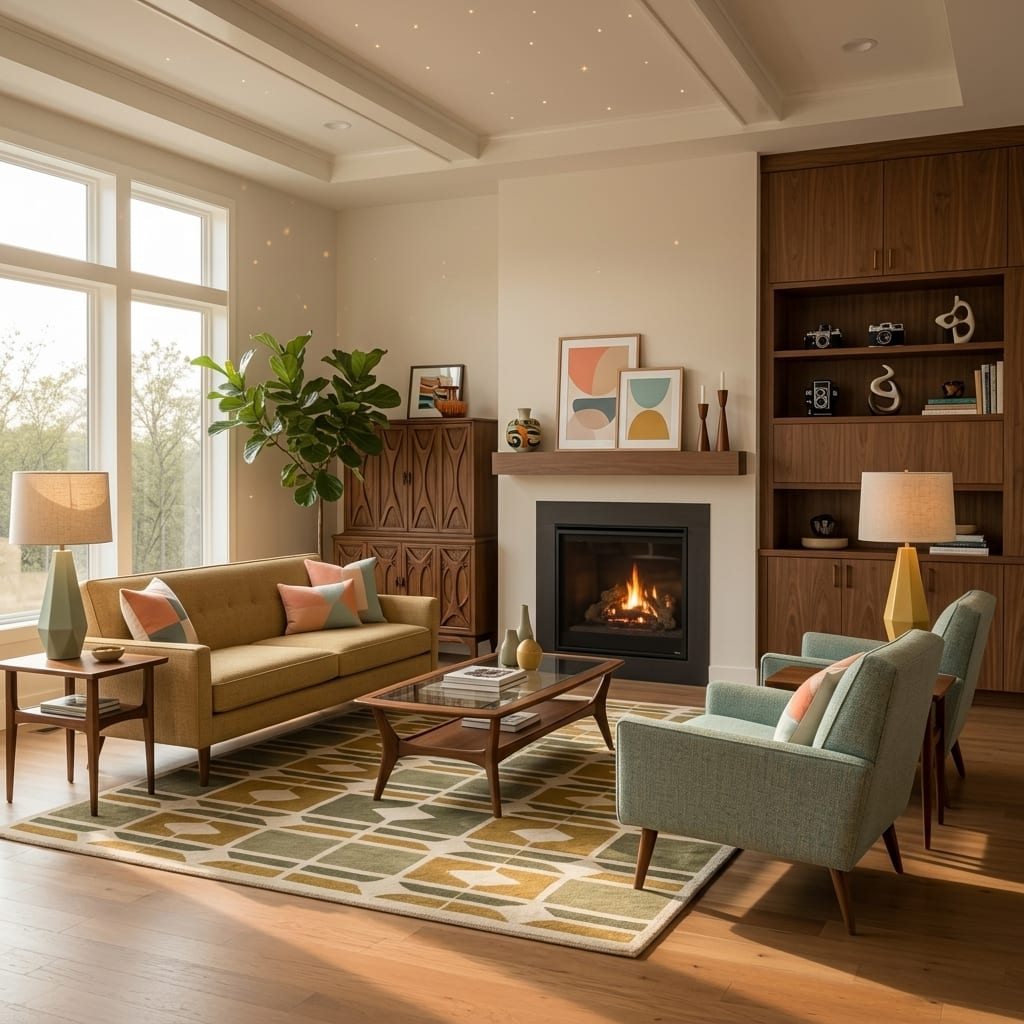
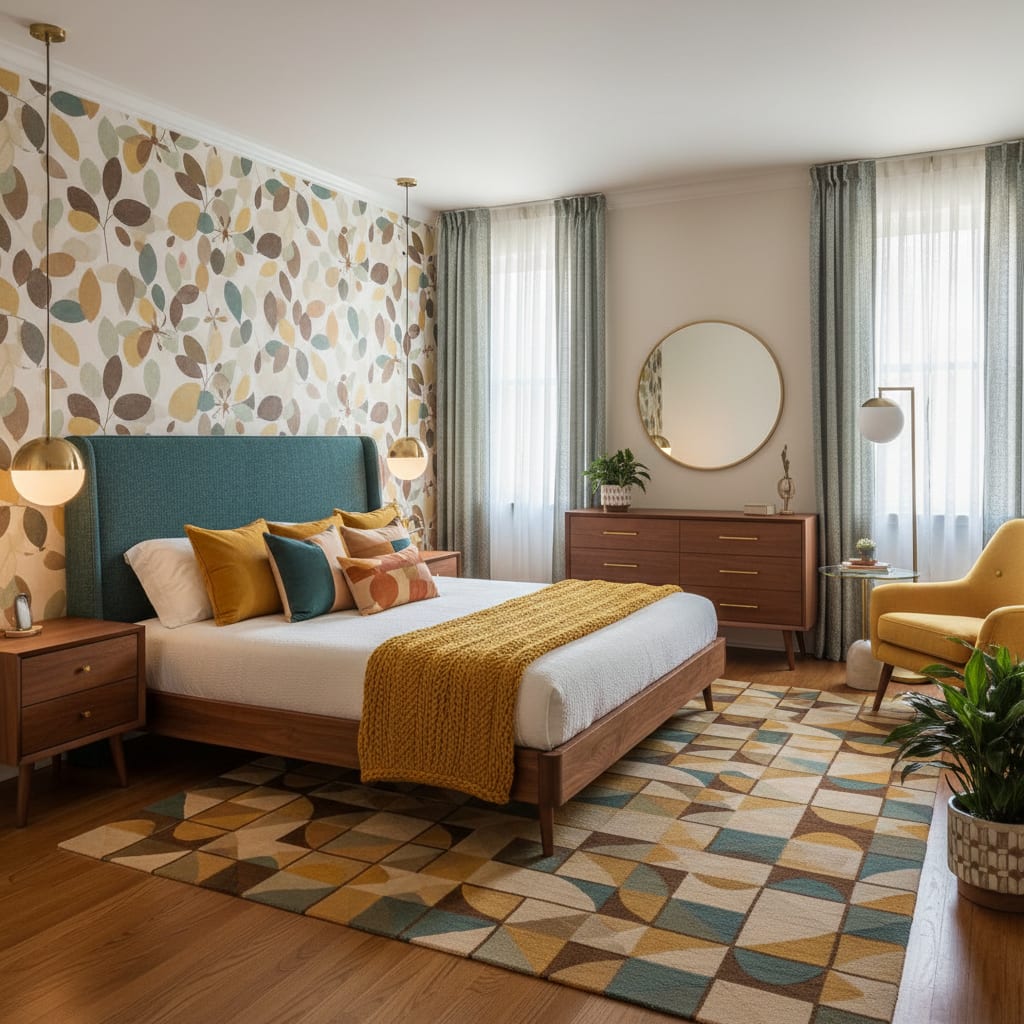
Mid-century modern is the post-war design period from roughly 1945 to 1969: low horizontal furniture on visible tapered legs, teak, walnut and rosewood with the grain showing, large glazing, warm neutral walls and one saturated accent — mustard, burnt orange, olive, teal. Five details carry the look, and none of them require a licensed reproduction.
What mid-century modern actually was
It was a manufacturing story before it was a taste. The war left behind moulded plywood, fibreglass, bent tubular steel and a generation of designers who had spent five years solving production problems. Then came the housing boom, and a market of young households who owned nothing and needed everything at once.
In the United States, Herman Miller and Knoll turned that into an industry. In Denmark, the annual Copenhagen Cabinetmakers’ Guild exhibitions had been pairing architects with cabinetmakers since 1927, and after the war that quiet system produced the export wave the world learned to call Danish Modern. In California, Arts & Architecture magazine ran the Case Study House programme from 1945 to 1966, commissioning cheap, buildable, glass-walled houses — which is where most of the imagery in your head comes from.
Nobody called any of it mid-century modern at the time. The phrase is retrospective: Cara Greenberg’s 1984 book Mid-Century Modern: Furniture of the 1950s named a period that had been over for fifteen years, and the label stuck because dealers needed one.
The period closes around 1969 because the language changes. By then you are into plastic, chrome, modular foam seating and pop colour, which is a genuinely different style even though it gets sold in the same shops.
The designers, and what each one actually did
The names matter less than what each one solved. That is the part you can steal.
| Designer | Base | What they contributed | Best-known piece |
|---|---|---|---|
| Charles and Ray Eames | US | Treated mass production as the design problem: moulded plywood, then fibreglass shells | Lounge Chair and Ottoman, 1956, for Herman Miller |
| Eero Saarinen | Finland / US | The pedestal base, to clear what he called the slum of legs under tables and chairs | Tulip chair and table, 1955–56, for Knoll |
| Arne Jacobsen | Denmark | Total design — the building, the chairs, the cutlery, the door handles | Egg and Swan chairs, 1958, for the SAS Royal Hotel, Copenhagen |
| Hans J. Wegner | Denmark | Joinery as the whole point; roughly 500 chair designs over a career | Wishbone Chair CH24, 1949, for Carl Hansen & Søn |
| George Nelson | US | As Herman Miller’s design director, hiring the others and inventing the storage wall | Bubble lamps, 1952 — though much of the office’s famous work was drawn by Irving Harper |
| Isamu Noguchi | US / Japan | Sculpture that you are allowed to use | Noguchi table, 1947; Akari paper lanterns from 1951 |
| Oscar Niemeyer | Brazil | The curve, in concrete — the Brazilian branch of the same moment | Brasília, from 1957 |
Two lessons from that table are worth more than any of the objects. Saarinen’s pedestal exists because he hated visual noise below knee height, which is why mid-century rooms feel calm even when they are full. And Wegner’s chairs are light — you can pick one up with one hand — which is why the style survives in small flats.
Teak, walnut, rosewood: reading the wood
Danish work is mostly teak and oak, with rosewood at the top end. American work — Herman Miller, Knoll — is mostly black walnut. That single fact will date a piece for you across a car boot sale.
Teak is a warm mid-brown that ages towards honey, and it is oily enough that it takes oil rather than lacquer, so a tired teak top can often be revived with a cloth and a couple of hours. Walnut is cooler and more chocolate, with straighter grain, usually lacquered from the factory. Rosewood is the dramatic one, dark streaks over a red-brown ground, and it comes with paperwork: Brazilian rosewood (Dalbergia nigra) has been on CITES Appendix I since 1992, and the rest of the Dalbergia genus went onto Appendix II in 2017. Buying a rosewood credenza in your own country is generally straightforward. Shipping one across a border often is not, so ask before you bid.
Almost all 1950s and 60s case goods are veneer over a core. That is not a defect — veneer is how you get that figure across a two-metre sideboard — but the veneer on a 1960s top is often under a millimetre thick, so you get to sand a water ring out of it roughly once, ever.
The rule that keeps a room from looking like a second-hand shop: pick two wood tones and stop there. One tone reads as a showroom set. Three or more reads as accumulation.
The five details that make a room read mid-century
- The leg line. Everything up on visible legs, with 15–20 cm (6–8 in) of floor showing beneath the sofa, the sideboard and ideally the bed. Legs taper — thicker at the top, around 4–5 cm, down to 2 cm at the floor — and they splay outward by 5 to 15 degrees, set in from the corners rather than at them.
- A low horizon. Sofa back 70–80 cm from the floor rather than 90. Coffee table 35–40 cm high, sitting 2–5 cm below the sofa seat. Then exactly one tall vertical in the room — a shelving unit, a floor lamp, a tall plant — so the low line has something to be measured against.
- Visible wood grain on at least three separate objects. Not one hero piece. And not painted.
- One saturated accent, used three times, at about 10% of the visible surface. Mustard, burnt orange, olive, teal. Repeat it at three different heights — floor, seat, eye — and the room stops looking like it has a cushion in it.
- Light at eye level, and warm. A globe, a cone or a paper shade with its centre around 150–170 cm, 2700K bulbs throughout, three separate light sources in a living room, and the ceiling fitting switched off after dark.
How to get it without buying a single reproduction
- Fix the shell first, because paint is cheap and it decides everything. Warm off-white on the walls — a white with a yellow or red base, not a grey one. Flat white ceiling. Skirting in the wall colour rather than gloss white.
- Lift the window line. Rod 10–20 cm above the frame, extending 15–25 cm past each side, full-length plain panels, no valance. The numbers for this are all in the curtain length and hanging guide.
- Buy the sideboard before the chair. Target 75–80 cm high, 40–45 cm deep, 140–180 cm long, tapered legs. It is the piece that does the most work and the easiest one to find second-hand at a sane price.
- Float the rug rather than filling the floor. Front legs of the sofa on the rug, 20–30 cm of bare floor left around the edges — mid-century rooms are supposed to show their floors. Sizes by sofa length are in the rug size guide.
- Now the seating. Measure before you buy: seat height 38–43 cm, seat depth 50–55 cm, slim arms. If you are buying an original, expect a 1960s three-seater to measure 180–190 cm and to seat two adults honestly.
- Two woods, one accent, three lamps. Then stop and live with it for a month.
Where the money goes, and what each tier actually buys you:
| What you buy | What you get | Where it lets you down |
|---|---|---|
| Licensed authentic (Herman Miller, Knoll, Carl Hansen, Fritz Hansen) | Correct proportions, current materials, warranty, resale value | Costs more than the rest of the room combined |
| Vintage original, unrestored | Real proportions, real age, and wood better than anything milled today | Foam, webbing and finish are sixty years old; restoration frequently exceeds the purchase price |
| Unlicensed reproduction | The silhouette, from across the room | Proportions drift — seats creep up, tapers flatten — and it shows next to a real one |
| High-street “mid-century” | A contemporary piece with tapered legs bolted on | 47 cm seat height, 100 cm depth, thick arms. Fine on its own, wrong beside anything real |
Mid-century modern versus contemporary
This is the confusion that sends people home with the wrong sofa. Shops use modern to mean not traditional, which is not what it means historically.
| Mid-century modern, 1945–69 | Contemporary, now | |
|---|---|---|
| Legs | Visible, tapered, splayed; 15–20 cm of floor beneath | Hidden — plinth, block base, or nothing |
| Seat height | 38–43 cm | 45–50 cm |
| Sofa depth | 80–90 cm overall | 95–110 cm, deeper seats |
| Wood | Teak, walnut, rosewood, grain forward | Light oak, ash, or painted matte |
| Neutrals | Warm — cream, oatmeal, camel | Cool — grey, greige, chalk |
| Accent | One saturated colour | Tonal and muted, or none |
| Lighting | Sculptural, warm, several points | Recessed and linear |
| Pattern | Geometric, atomic, stripe | Mostly plain |
If you want the wider map of how this sits against Scandinavian, japandi, industrial and the rest, the interior design styles guide lays out all of them side by side, and the mid-century style page shows the palette applied.
Mid-century in a flat with no architectural bones
The style was born in houses with glass walls, open plans and a masonry fireplace core. You probably have a 2.4–2.6 m ceiling, one window, hollow-core doors and a radiator under the glazing. Four things still transfer.
Horizontal continuity does the most. Run the top of the sideboard, a floating shelf and the top of the media unit at the same height across one wall — 75 cm is a good default — and a plain box of a room suddenly has a datum line. This is the cheapest architectural move available to you.
Widen the apparent glazing by stacking full-height panels entirely on wall, not on glass. Make one architectural gesture: an open shelving unit used as a room divider, or a slatted wood screen 40–60 cm wide beside the window. And change the ironmongery — swapping round chrome knobs on hollow-core doors for long levers changes a corridor more than a picture will.
Do not fake a fireplace. A stone-effect panel with no flue behind it is the one move that undoes everything else.
If you want to check whether warm off-white walls and a low sideboard actually rescue your particular room before you commit to paint, Architectural AI will run the mid-century style on a photo of the room you are standing in, and the mid-century living room and mid-century bedroom worlds show the two rooms where it lands hardest. It renders a look, not a plan — it does not know your ceiling height or where the radiator sits, and the furniture in the image is not a product you can buy. Use it to settle direction, then go and measure.
Where it goes wrong
The showroom room is the common failure: matched suite, everything made between 1950 and 1965, nothing in the space that anyone inherited. Real 1958 houses had a grandmother’s chair in them. Mixing eras deliberately is what blending two decor styles is for.
Buying the hero chair first is the expensive failure. The chair cannot rescue a room whose leg line is wrong, and you will have spent the budget.
Then the practical ones. Original 1960s foam is almost always finished — crumbling, yellowed, and it smells; budget for refoaming before you buy a vintage sofa, not after. Teak fades on the window side, so a piece that has stood in front of glass for decades will be two colours. Sun-bleached veneer can be evened out; a lifted or bubbled veneer edge cannot, cheaply.
And the honest limit: a room with one small window and a 2.3 m ceiling will not become a Case Study house, and dark teak in a genuinely north-facing room reads heavy no matter how correct the proportions are. In that room, go for oak, keep the walls warm, and take the win.
FAQ
What years are mid-century modern?
Roughly 1945 to 1969, with the strongest decade running from about 1950 to 1962. Some writers stretch the start back to the 1930s to include Bauhaus émigrés arriving in the United States, and the end is fuzzy because the late 1960s slide into plastic, chrome and pop, which is a different language. The name itself is retrospective: Cara Greenberg’s 1984 book put it into circulation.
What is the difference between mid-century modern and modern?
In design history, modern means the modern movement, roughly the 1880s to the 1960s, and mid-century modern is its last chapter. Contemporary means whatever is being made right now, so it moves every year. In a shop, modern usually just means not traditional. Practically, the differences you can see are legs, seat height and colour temperature: mid-century sits low on visible tapered legs in warm neutrals, contemporary sits high on plinths in cool greys.
Do I need real designer furniture for a mid-century modern room?
No. A room reads mid-century because of proportion, leg line and palette, not because of a licensed chair. A second-hand sideboard 75–80 cm high and 40–45 cm deep on tapered legs, a sofa with a 38–43 cm seat height, warm off-white walls and one saturated accent will land the style convincingly. One expensive chair in a room of deep contemporary sofas reads as an expensive chair, not as mid-century modern.
What colours work in a mid-century modern room?
Warm neutrals as the base — cream, oatmeal, putty, camel, and a white with a yellow or red undertone rather than a grey one. Then one saturated accent from the period palette: mustard, burnt orange, olive, teal or a deep rust. Use it on about 10% of the visible surface and repeat it in three places at different heights. Cool grey walls flatten the style faster than any other single choice.
How do I stop a mid-century room looking like a furniture showroom?
Break the date. The tell of a pastiche room is that every object was made between 1950 and 1965, which never happened in a real 1950s house. Add a contemporary rug, a plain linen sofa, a modern lamp or a piece of family furniture from another era, aim for roughly 70% neutral shell and 30% period, and never buy a matching suite. Mixing makers is historically correct.
Can you do mid-century modern in a small apartment?
It suits small flats better than most styles, because everything stands on legs and you keep seeing the floor under it, which makes a room read larger. The constraint is depth, not floor area: mid-century sofas are 80–90 cm deep against 95–110 cm for contemporary ones, so they fit where a modern sofa will not. Original 1960s three-seaters are often only 180–190 cm long.
Keep reading