Reading Nook Ideas: Light, Chair and Shelves That Work
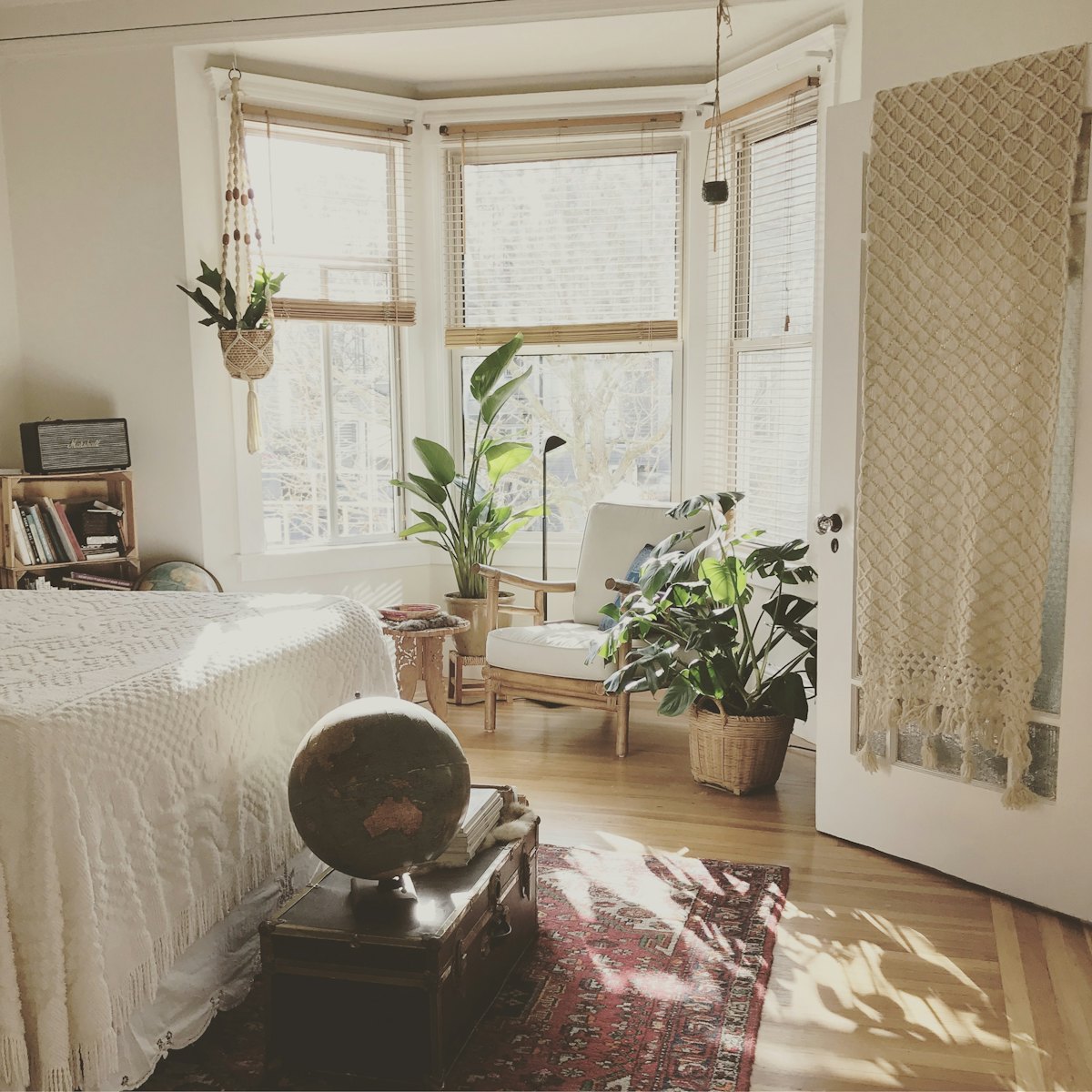
Most reading nooks get built back to front. You start with a chair you liked in a shop, add a throw and a plant, photograph it, then never sit there for more than ten minutes. The two things that decide whether you read for an hour — where the light comes from and how deep the seat is — are the ones nobody measures.
Put the lamp behind and to one side of your shoulder, shade bottom at 100–120 cm (39–47 in), just under seated eye level. Use a 700–900 lumen bulb at 2700–3000 K on a dimmer, for 300–500 lux at the page. Sit at 50–55 cm seat depth and a 100–110° back angle, side table level with the armrest.
The lamp goes behind your shoulder, never overhead
A ceiling light above a reader gets two things wrong at once: it drops your own head shadow across the page, and on coated paper it bounces a reflection back at you. You tilt the book, then you hunch. That is the ache after twenty minutes. The fix is geometry — light arriving over your shoulder at an angle, page lit, source out of your sightline. If you annotate, put it opposite your writing hand.
| Spec | Target | Why it matters |
|---|---|---|
| Light at the page | 300–500 lux (500–750 over 60) | Below ~200 lux you slow down and lean in |
| Bulb output | 700–900 lm (8–10 W LED) | Delivers that at 40–60 cm from the page |
| Colour temperature | 2700–3000 K evening, 3500–4000 K day | Warm light reads as rest, not office |
| CRI | 90+ | Only matters for art and photography books |
| Shade bottom height | 100–120 cm / 39–47 in | Below seated eye level, so no bulb glare |
| Lamp offset | 25–40 cm behind, 30–50 cm to the side | Page lit, source outside your view |
| Surround brightness | Roughly a third of the page | A bright pool in a black room is tiring |
That last row is the one people skip. A single lamp in an otherwise dark room makes your pupils re-adjust every time you look up. Leave a second low light on somewhere and the corner gets more comfortable without getting brighter.
Seat depth and back angle: what makes an hour possible
A dining chair holds you at 90–95° with about 45 cm of seat under you. Correct for eating, wrong for reading: nothing to lean into, unsupported thighs at the front edge.
| Chair type | Seat height | Seat depth | Back angle | Armrest above seat |
|---|---|---|---|---|
| Dining chair | 45–47 cm (18 in) | 43–46 cm (17–18 in) | 90–95° | — |
| Desk chair | 42–52 cm | 40–48 cm | 95–100° | 20–25 cm |
| Reading chair | 38–43 cm (15–17 in) | 50–55 cm (20–22 in) | 100–110° | 18–22 cm |
| Deep lounge chair | 35–40 cm | 55–62 cm | 110–120° | 15–20 cm |
The deep lounge chair is a trap under about 165 cm of height: at 60 cm of seat depth your feet leave the floor before your back reaches the backrest. Two 12 cm cushions fix it. Past 110° you need a headrest, or your neck holds itself up all evening. The armrest matters most — at 18–22 cm above the compressed cushion your forearm rests without your shoulder shrugging, which is what lets you hold a hardback. Measure it with someone sitting in the chair; foam compresses 3–5 cm.
Setting it up, in order
- Sit with a real book for five minutes. Crossing your ankles or sliding forward means the seat is too deep or the back too upright.
- Measure compressed seat to armrest top. That plus seat height is your side table height, usually 55–65 cm.
- Put the table within 25 cm of the armrest, top at least 30 × 30 cm. Further away and the cup ends up on the floor.
- Add a footstool 5–10 cm below seat height — 30–38 cm — and 35–45 cm deep, 15–25 cm in front.
- Position the lamp last, sitting in the chair while someone else moves it, until you cannot see the bulb and no shadow crosses the gutter.
- Leave 45–60 cm of clear floor in front. Chair, stool and table want roughly 1.1 × 1.5 m, about 1.6 m².
Five small-footprint versions with real dimensions
The window bay
Depth 50–60 cm, finished height 40–45 cm including a cushion of 8–10 cm foam. Length sets the use: 120 cm to sit sideways with your knees up, 180 cm to lie down. A 15 cm back cushion eats depth, so build the box at 55 cm. Radiator underneath? Grille it with a 5–8 cm gap at the top, never box it in solid.
A corner under 1.5 m²
A 120 × 120 cm corner is 1.44 m². Armless chair 65–70 cm wide and 70–75 cm deep set at 45° across it, floor lamp in the apex behind, 35–40 cm round table on the open side, shelves at 140 and 175 cm. No footstool — use a 42 cm seat and plant your feet.
The landing or hallway end
Only works at a dead end, because 90 cm of walking lane stays clear no matter what. You need 100–120 cm of depth beyond that lane: a 65–70 cm chair plus a 30 cm shelf fits exactly. Wall or clamp light rather than a floor lamp — you will trip on the cable in the dark eventually.
A wardrobe alcove
Recesses are usually 60 cm deep, the standard hanging depth, and 80–120 cm wide. Pull the rail out, run a bench across at 45 cm high, and you can sit cross-legged in it. Below 90 cm of interior width it becomes a perch. The catch is power: wardrobes rarely have a socket, so plan on a rechargeable lamp.
The reading chair inside a living room
The version most people should build. Chair 100–120 cm from the nearest sofa arm, turned 20–30° towards it, 75–90 cm of circulation behind. Not facing the television — the point of this chair is that it is the seat that isn’t for screens. Tape the footprint out first, as with rug sizing.
The home library: depth, span, weight, fixings
| Book type | Shelf depth | Clear height between shelves |
|---|---|---|
| Mass-market paperbacks | 15–18 cm | 20–22 cm |
| Trade paperbacks | 18–20 cm | 22–24 cm |
| Standard hardbacks | 22–25 cm | 28–30 cm |
| Art and photography books | 30–35 cm | 35–40 cm |
Standard bookcases are 28–30 cm deep: fine for hardbacks, but paperbacks sit in a 10 cm dust recess. Mixing depths on purpose — deep at the bottom for art books, shallow above — looks better and costs less. Then span, because a shelf does not break, it bows, slowly enough that you stop noticing.
| Material | Max span under book load |
|---|---|
| 16 mm particle board / melamine | 55–60 cm |
| 18 mm MDF | 60–70 cm |
| 18 mm birch plywood | 75–80 cm |
| 18 mm solid pine or oak | 80–90 cm |
| 25 mm solid oak | 100–110 cm |
| 10 mm toughened glass | 60–70 cm |
| Any of the above + 40 mm front lip | roughly +30% |
A 40 mm hardwood strip glued along the front edge buys stiffness out of all proportion to its cost, because stiffness scales with depth cubed. It also hides an LED strip.
Weight is what surprises people. Paperbacks run 18–22 kg per linear metre, mixed hardbacks 25–35 kg, art books 40–50 kg — so a filled five-shelf bookcase 80 cm wide is 100–140 kg on four small feet. Anything over about 120 cm tall gets screwed to the wall, no exceptions with children in the house, and floating shelves are for ten books rather than a hundred.
Know your wall. A modern partition is 12.5 mm plasterboard on studs at 400 or 600 mm centres, and plasterboard anchors carry a plausible load in a lab and a disappointing one in board already drilled twice. Over roughly 25 kg per bracket, find the studs and space your uprights to match. Older masonry takes a plug and a 6–8 mm screw and outperforms anything fixed to board. Once it is up, styling the shelves is the easy half.
Lighting the shelves
Shelf light is not reading light, and asking it to be both is why library corners end up looking like shop displays. Run an LED strip at the front underside of each shelf, behind that 15–20 mm lip, pointing down at the spines: 300–500 lm per metre at 2700–3000 K for accent, 700–900 lm/m on a dimmer if the shelves are the room’s main light. Mount it at the back and you light the wall while the books sit in their own shadow. Direct sun fades spines faster than anything else in a house, so on a south-facing wall a sheer layer is doing real work — the curtain length guide covers mounting heights.
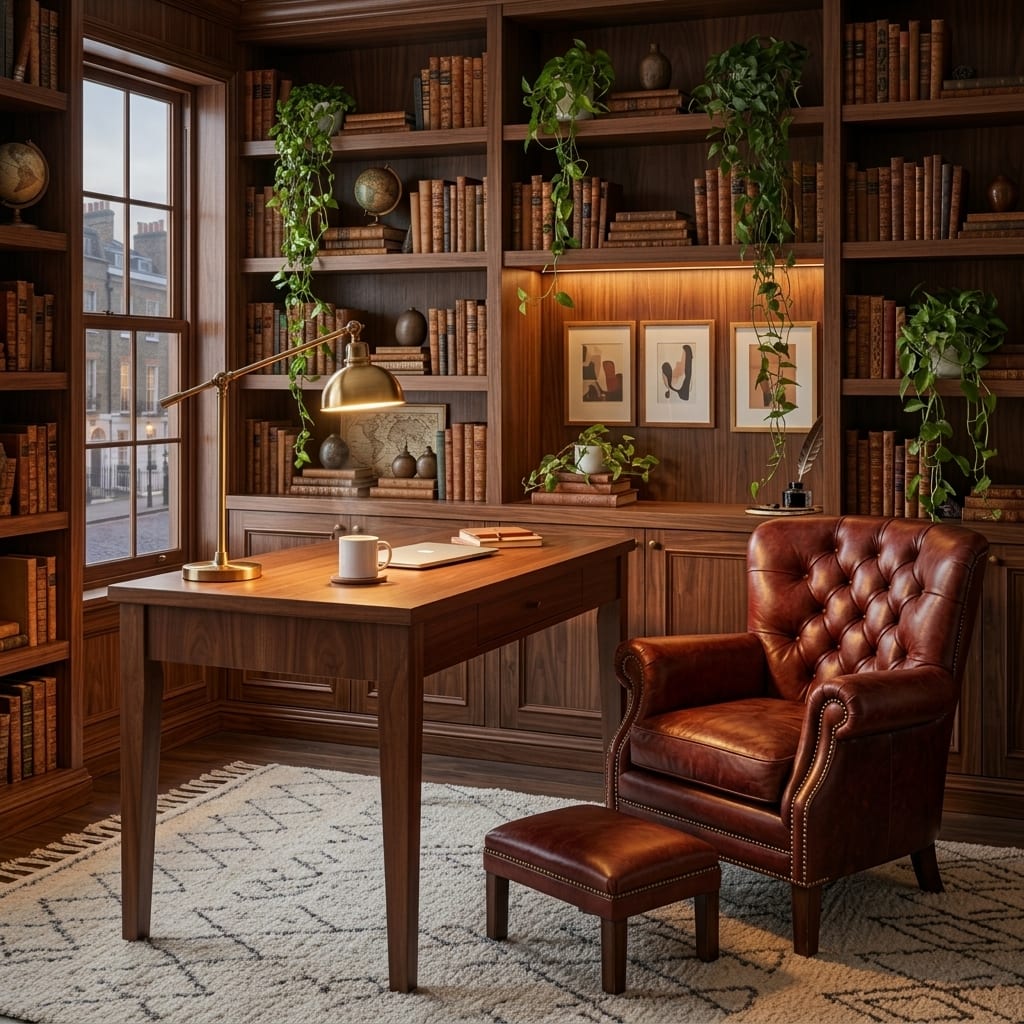
A dark, low-reflectance wall makes a small library read as deliberate rather than dim, which is the trick behind dark academia rooms. The cozy library and dark academia worlds in Architectural AI let you photograph the corner and see it in deep green before buying a tin. It renders a look, not a measured plan — it has no idea where your studs are.
What actually goes wrong
It is dark. A nook lit only by the room’s ceiling light is a chair, not a reading spot. This is the most common reason a well-styled corner goes unused, and it costs a lamp to fix.
It is cold. Sitting still you want the room 1–2 °C warmer than when moving, so 21–22 °C rather than 20 °C. The two most photogenic spots, the bay window and the landing, are also the coldest places in most homes: a single-glazed pane at 5 °C outside sits near 10 °C on its inner face and quietly pulls heat off whoever is beside it. Move the chair 20 cm off the glass, layer a heavy curtain over a sheer, put a rug underfoot, keep a throw there.
It is in the wrong room. A nook in the spare bedroom gets used enthusiastically for two weeks. You read where you already are in the evening, so build the chair into the living room even though a dedicated room sounds better — the same logic that makes a two-square-metre desk corner beat an office you have to walk to.
None of this creates reading time, and no chair competes with a phone. If the phone is the problem, the useful design decision is a side table with no charger on it.
FAQ
Where should the lamp go in a reading nook?
Behind and slightly to one side of your shoulder — about 25–40 cm back and 30–50 cm across — with the bottom of the shade at 100–120 cm off the floor. That sits just below seated eye level, so the page is lit but the bulb stays out of view. A light directly overhead drops your own head shadow onto the book and glares off coated paper.
How many lumens do you need to read comfortably?
Aim for 300–500 lux at the page, which a 700–900 lumen bulb delivers from a shade 40–60 cm above the book. Readers over 60 need roughly double that, so go to 1,100–1,500 lumens or move the lamp closer. Fit a dimmer rather than buying a bulb you can only run flat out.
What seat depth and back angle work for a reading chair?
Seat depth of 50–55 cm and a back angle of 100–110°. That is deeper and more reclined than a dining chair, which sits at 43–46 cm and 90–95°. Seat height should also be lower, 38–43 cm rather than 45–47 cm, and a footstool 5–10 cm below the seat keeps your thighs supported to the knee.
How deep should bookshelves be for books?
Paperbacks need 15–20 cm of depth, standard hardbacks 22–25 cm, and large art or photography books 30–35 cm. Most off-the-shelf bookcases are 28–30 cm, which covers hardbacks but leaves paperbacks in a dust recess. Clear height between shelves: 22 cm for paperbacks, 28–30 cm for hardbacks, 35–40 cm for art books.
How far can a bookshelf span before it sags?
Under a normal book load, 16 mm particle board sags past about 55–60 cm, 18 mm MDF past 60–70 cm, 18 mm birch plywood past 75–80 cm, and 18 mm solid hardwood past 80–90 cm. A 25 mm solid board reaches 100–110 cm. A 40 mm lip glued along the front edge adds roughly a third.
How much does a metre of books weigh?
Roughly 18–22 kg per linear metre for paperbacks, 25–35 kg for mixed hardbacks, and 40–50 kg for large art books. A filled five-shelf bookcase 80 cm wide carries 100–140 kg on four small feet. That is why anything over 120 cm tall must be fixed to the wall, and why brackets on plasterboard need to hit the studs.
Keep reading