Feng Shui Bedroom Layout Rules, Measured in Centimetres
Feng shui bedroom advice arrives as one long list that mixes two kinds of rule: spatial decisions any competent designer reaches without the philosophy, and symbolism that only works if you accept it. Nothing tells you which is which. Here is the list with the labels put back on, each rule written as a position you can measure.
Put the head of the bed against a solid wall, positioned so you can see the bedroom door from the pillow without being directly in line with it — usually the wall diagonally opposite the door. Leave 60–75 cm (24–30 in) of clear floor on both long sides, 90 cm (36 in) at the foot if you walk past it, and keep the bed out from under the window.
The command position, measured
From the pillow you should see whoever comes through the door, without the bed sitting in the doorway’s line of travel. That resolves to the headboard on the wall diagonally opposite the door, with the door in your field of view at roughly 45 degrees.
The bad case, which tradition calls the coffin position, is the foot of the bed pointed straight at an open door. The other is the bed on the same wall as the door, where you cannot see the entrance without sitting up.
Tradition explains this as chi flowing through the doorway. Practically, a corridor door throws light and sound in a straight line, and a bed in that line catches all of it. Environmental psychology has a matching idea — prospect and refuge, a protected back with a clear view of the approach. That is a theory about preference, not a proven mechanism, but it is the same intuition from the other side.
If your room only allows the bed in line with the door, put height between them: a bench at the foot, a low chest, a chair.
The headboard needs a solid wall, never a window
A headboard against a solid wall stops the pillows sliding into a gap, puts mass between you and whatever is behind, and fixes the bed as the thing the room is organised around.
A window fails all three. It is the coldest surface in the room on a winter night, it is where condensation forms, and in most flats the radiator sits directly beneath it — so a bed there blocks the heat and bakes one side of the mattress. Curtains also want to hang past the frame and reach the floor, which a bed makes impossible; the curtain length and hanging guide has those clearances.
Three cases where you do it anyway: a bay deep enough that the bed sits in front of the glass; a room where every other wall holds a door or a wardrobe; a loft whose only full-height wall is glazed. In all three, use a tall solid headboard, leave 10–15 cm of air between headboard and glass, and hang a lined curtain that stops above the mattress. Avoid the wall shared with a bathroom stack if you can — you hear the pipes.
Clearance on both sides: the rule that changes daily life
Highest practical payoff, least mysticism attached. Without walkable floor on both long sides, one person climbs over the other, one side of the bed never gets made properly, and the room reads as furniture crammed into a box.
| Bed | Size | Min room width (70 cm both sides) | Comfortable (90 cm both sides) | Depth for a walking route |
|---|---|---|---|---|
| Single | 90 × 200 cm (35 × 79 in) | 230 cm — or 160 cm with one side to a wall | 270 cm | 290 cm |
| Double | 140 × 200 cm (55 × 79 in) | 280 cm | 320 cm | 290 cm |
| Queen (US) | 152 × 203 cm (60 × 80 in) | 292 cm | 332 cm | 293 cm |
| King (UK) | 150 × 200 cm (59 × 79 in) | 290 cm | 330 cm | 290 cm |
| King (US) | 193 × 203 cm (76 × 80 in) | 333 cm | 373 cm | 293 cm |
| Super king | 180 × 200 cm (71 × 79 in) | 320 cm | 360 cm | 290 cm |
Read that as a buying constraint. A 300 cm wide bedroom cannot hold a US king with usable sides, and the honest answer is a smaller bed rather than a clever layout. Below 50 cm you turn sideways every time you pass.
Two nightstands, one each side, is sold as a relationship rule. It is also two people, two lamps, and nobody reaching across. Match the nightstand top to within 5 cm of the mattress top; the furniture arrangement rules guide has the same numbers for the rest of the house.
The mirror facing the bed
The most repeated rule, explained worst. Tradition says a mirror opposite the bed bounces energy back and, in some readings, invites a third party into a relationship.
Practically, it reflects the doorway, the window and any movement straight at the pillows — at 3am, headlights sweeping the ceiling and your own movement. Not a health claim. Just a thing people find irritating and then invent a reason for.
- Move it to the inside of a wardrobe door. Full-length, useful, invisible when closed.
- Hang it on the same wall as the headboard, reflecting the far wall instead of you.
- Put it on a perpendicular wall, angled out of the bed’s line of sight.
- Cover it at night. Works, and looks like a solution to a problem you refused to solve.
Fully mirrored wardrobe fronts are the rented-flat trap. A tall plant or a curtain panel on a tension rod across the nearest section handles it.
Doors, en-suites and what hangs overhead
An en-suite door facing the bed is the second most cited problem. Tradition frames it as drainage. What reaches you is humidity, the light when someone gets up, and the extractor fan. Keeping it closed is free; if the room allows, put the bathroom beside you rather than in front.
Overhead I would take the tradition seriously, for different reasons. Beams, a ceiling sloping to pillow height, an air-conditioning unit and shelves above the headboard are all listed as oppressive. A shelf full of books over your head is a bad idea in any tradition, and in a seismic zone it is a hazard. If the ceiling slopes, put the pillows where it is highest.
Check door swings first: a standard internal door needs 75–80 cm of arc, a hinged wardrobe leaf 55–60 cm.
Lay out the room in 20 minutes
Do this with masking tape before you move anything heavy. The six-step rearranging method covers the rest.
- Mark the door swings — entrance, wardrobe, en-suite, balcony. Nothing goes inside those arcs.
- Tape the bed footprint at true size, including 8–12 cm of headboard depth. Try the wall diagonally opposite the door first.
- Walk both sides. If either is under 60 cm, the bed is too big for the wall you chose, not for the room.
- Check the foot. 90 cm if it is a route to the wardrobe or window, 70 cm if it dead-ends.
- Place the nightstands — 40–50 cm wide, top within 5 cm of mattress height. On a 60 cm side, use a wall shelf.
- Check the sightline. Sit on the taped rectangle at pillow height. Can you see the door without turning your whole body? If not, rotate the plan.
- Then the rug — under the bed, 45–60 cm past the sides, usually one size up from what looks right in the shop. Sizes are in the rug size guide.
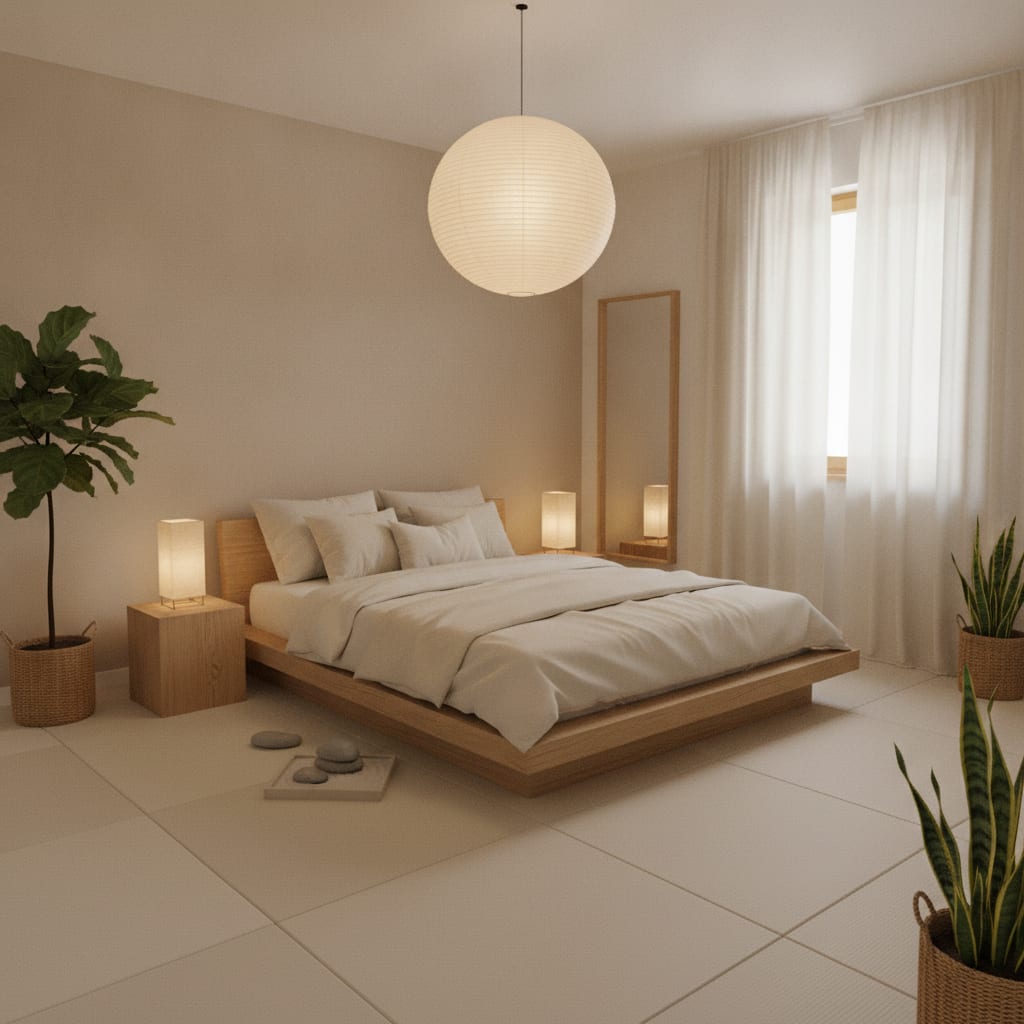
To compare layouts before dragging a mattress across the room, photograph it and preview: Architectural AI restyles that photo into a zen bedroom or a japandi one. It renders a look, not a measured plan, so keep the tape for the numbers above.
Bagua and kua numbers: the honest answer
Here the practical and the traditional part company, and I would rather say so than fudge it.
The bagua is an eight-sector grid laid over your floor plan, each sector standing for an area of life. Classical compass schools orient it by actual compass direction; the Western BTB school aligns it to the wall your front door sits in. Those two methods put the same sector in different rooms of the same flat, and both claim accuracy. That disagreement is the whole answer.
The kua number derives from your birth year and gender and yields four favourable directions to sleep facing. Internally consistent, not measurable. If it puts the headboard under the window or the foot of the bed in line with the door, ignore it — the rules above have reasons you can state in a sentence, and the direction does not.
From the symbolic layer I would keep three habits: work out of the bedroom, think in pairs, own less. Colour by compass direction is one palette suggestion among many; the bedroom colour guide argues them on light and orientation instead.
What this can’t fix
A layout cannot make a small room big. If your bedroom is 9 m² with a door, a window and a wardrobe wall, there is one place the bed goes, and every rule above describes what you already did.
It cannot fix street noise or the flat above, compensate for a bad mattress, or stop you looking at your phone at midnight. Feng shui lists tend to promise outcomes that belong to habits, building fabric or glazing, then quietly take credit.
In a rented room with a built-in bed platform, take the free parts: close the en-suite door, deal with the mirror, add a lamp on each side, stop there. The calming bedroom guide is more use than a compass.
FAQ
What is the correct feng shui bed position?
The command position: the head of the bed against a solid wall, positioned so that from the pillow you can see the bedroom door without being directly in line with it. In practice that is usually the wall diagonally opposite the door. You get a sightline to the entrance without lying in the path of corridor light, sound and draught.
Can the bed be under a window in feng shui?
Tradition says no, and the practical reasons are stronger. A window gives no solid headboard wall, it is the coldest surface in the room in winter, and in most flats the radiator sits directly under it. If it is the only workable wall, use a tall solid headboard, leave 10–15 cm of air behind it, and add a heavy lined curtain.
How much space should be on each side of the bed?
For a bed two people use, leave 60–75 cm (24–30 in) of clear floor on both long sides — enough to walk past, make the bed and get out without climbing over anyone. Below 50 cm you turn sideways every time you pass. At the foot, allow 90 cm (36 in) for a walking route, or 70 cm if it dead-ends.
Why shouldn’t a mirror face the bed?
Traditionally, a mirror facing the bed is said to bounce energy back and, in some readings, invite a third person into a relationship. The practical reason is simpler: at night it reflects the doorway, streetlight and any movement in the room straight at the pillows. Move it to the inside of a wardrobe door, or onto the headboard wall.
Does feng shui actually work?
The layout rules work, but not for the reason the tradition gives. Command position, clearance on both sides, a solid headboard wall and nothing heavy overhead all have plain practical explanations that experienced designers reach without the philosophy. Compass sectors, kua numbers and colour-by-direction have no measurable mechanism, so treat those as taste.
What should you not put in a bedroom according to feng shui?
The usual list: mirrors facing the bed, beams or loaded shelves over the pillows, a desk or gym equipment in the sleeping zone, water features and screens. Three have practical backing — overhead mass is a genuine hazard, work equipment keeps the room reading as an office, and screens add standby light. Water features are symbolism.
Keep reading